Hip Thrust Machine
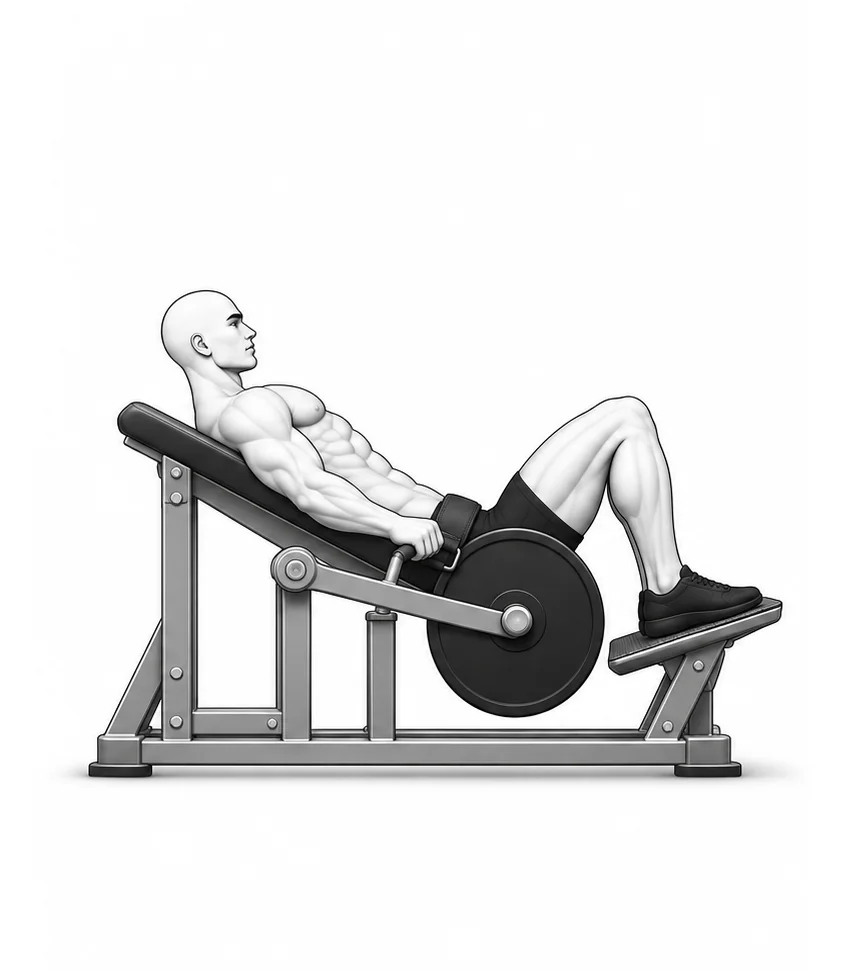
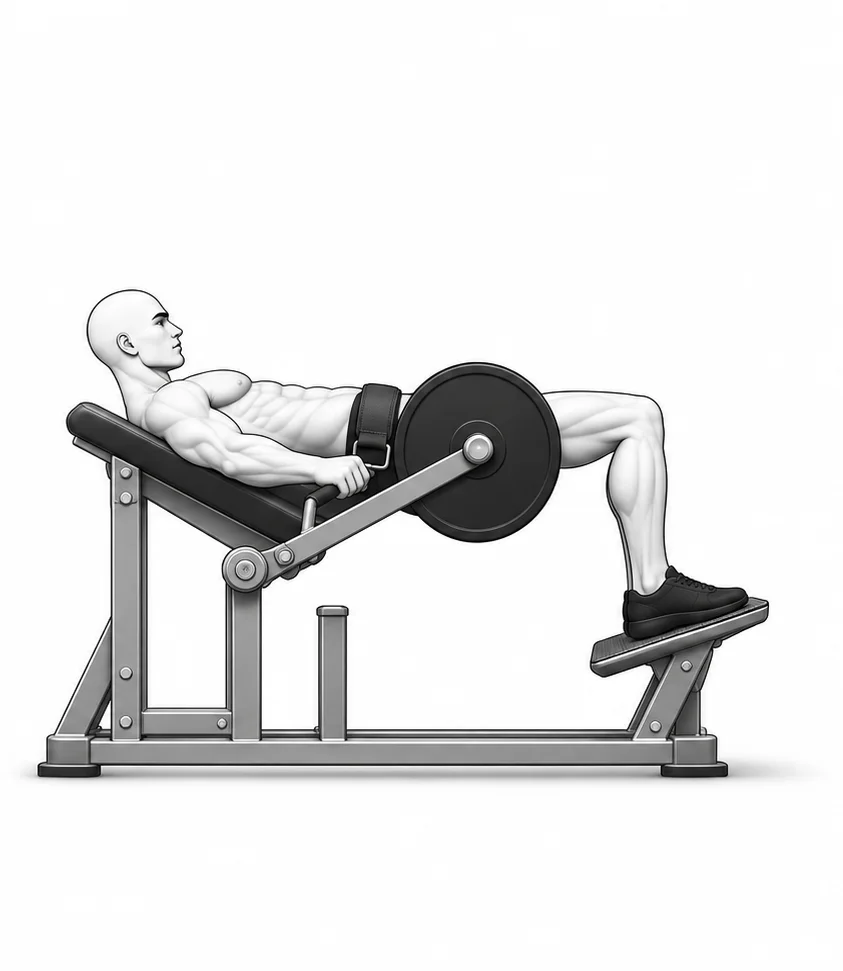
The hip thrust machine trains your glutes by straightening your hips against a padded belt or lever. With your upper back against a pad and your feet flat, you drive your hips up until your body is level from shoulders to knees, then lower them back down.
- TYPE
- Isolation: only the hips move; the knees hold a fixed bend
- PRIMARY MUSCLES
- Glutes
- ALSO WORKING
- Hamstrings, adductors, quads a little
- EQUIPMENT
- Hip thrust machine
- DIFFICULTY
- Beginner
Form images
Muscles worked
- PRIMARY
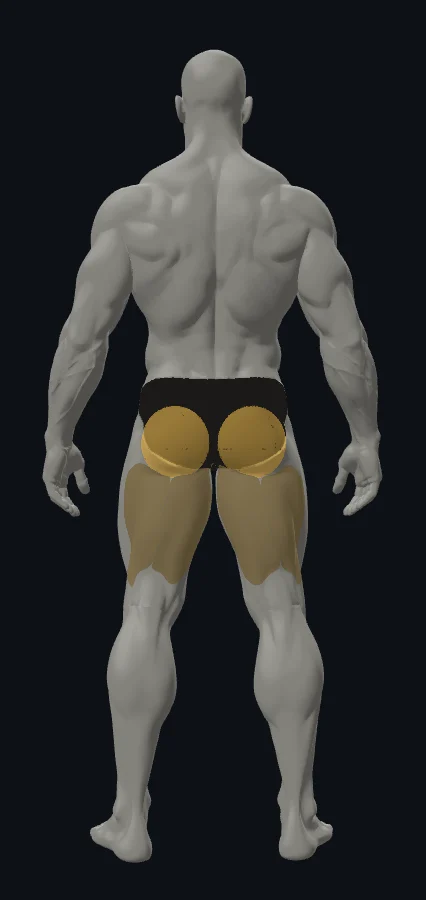
- Glutes
- ASSISTING
- Hamstrings, adductors, quads a little
The hip thrust machine is mainly a glute exercise, helped by the hamstrings and adductors.
- Glutes straighten your hips and do most of the work. In untrained adults, nine weeks of hip thrusts grew the glutes about as much as the same number of sets of back squats [1].
- Hamstrings and adductors help straighten the hips.
- Quads hold the knee bend. Squats grew the quads and adductors more than hip thrusts did [1], so the hip thrust doesn't replace a squat or leg press.
Setup
- Sit on the machine with the edge of the back pad just below your shoulder blades.
- Fasten the belt or set the lever across your hip bones, snug but not pinching.
- Place your feet about hip-width apart on the platform, toes slightly out, so your shins are near vertical at the top.
- Release the safety on your first rep, if the machine has one.
How to do it
- Drive through your heels to lift your hips.
- Keep your chin tucked and your eyes forward, so your ribs stay down.
- Finish with your hips fully straight and your body level from shoulders to knees.
- Squeeze your glutes for a moment at the top.
- Lower under control until your hips are near the seat.
from hips lowered near the seat to hips fully straight.
a steady drive up, a 1-second squeeze, about 2 seconds down.
Common mistakes
Arching the lower back at the top
Your lower back finishes the rep instead of your glutes
Stop when your hips are straight; keep your ribs down and chin tucked.
Feet too far forward
The hamstrings take over
Bring your feet in until your shins are near vertical at the top.
Feet too close
The quads take over and your heels lift
Move your feet out until your heels stay down.
Bouncing off the bottom
Momentum replaces the glutes
Lower under control and pause briefly before the next rep.
Make it easier or harder
It's the same movement from a bench, but you have to balance the bar on your hips.
Variations and alternatives
Glutes, with bodyweight
You're learning the movement or training at home.
Glutes, with free-weight loading
You don't have the machine, or you've outgrown its stack.
Glutes, plus far more quads and adductors [1]
You want one lift that trains the whole leg.
Hamstrings and glutes at a long stretch
You want a hip hinge that also trains the hamstrings.
Where to fit it into your workout
After your main squat or leg press, or first in a glute-focused session.
Sets and reps: 3 sets of 8–15 reps. Heavy and light loads built similar muscle when the sets ended close to failure [2].
Rest: 90 seconds.
How often: train your glutes at least twice a week [3].
What to pair it with: a squat or leg press for the quads, and a hamstring lift.
Safety
- Fasten the belt before you add weight, and keep it across your hip bones, not your stomach.
- Keep your ribs down at the top. Don't push into a lower-back arch to finish the rep.
- Check with a doctor or physical therapist first if you have an injury, pain or a medical condition, or are pregnant.
- Stop the set if you feel sharp pain, joint pain, dizziness or chest pain. Muscle burn and effort are normal; pain is not.
- This page is general information about exercise technique. It isn't medical advice and doesn't replace advice from a professional who knows your health. See our Terms of Service.
Questions people ask
What does the hip thrust machine work?
Mainly your glutes, with your hamstrings and adductors helping.
How do I feel hip thrusts in my glutes?
Set your feet so your shins are vertical at the top, drive through your heels, tuck your chin, and squeeze at the top without arching your lower back.
Is the hip thrust better than squats for glutes?
Not clearly. Hip thrusts and squats grew the glutes by similar amounts when the number of sets was matched; squats also grew the quads and adductors more [1].
Can I do hip thrusts on the floor with a weight?
Yes: the glute bridge with a dumbbell or plate on your hips trains the same movement with a shorter range.
Sources
- 1Plotkin DL, Rodas MA, Vigotsky AD, et al. Hip thrust and back squat training elicit similar gluteus muscle hypertrophy and transfer similarly to the deadlift. Front Physiol. 2023;14:1279170.
- 2Schoenfeld BJ, Grgic J, Ogborn D, Krieger JW. Strength and hypertrophy adaptations between low- vs. high-load resistance training: a systematic review and meta-analysis. J Strength Cond Res. 2017;31(12):3508–23.
- 3Schoenfeld BJ, Ogborn D, Krieger JW. Effects of resistance training frequency on measures of muscle hypertrophy. Sports Med. 2016;46(11):1689–97.