Barbell Hip Thrust
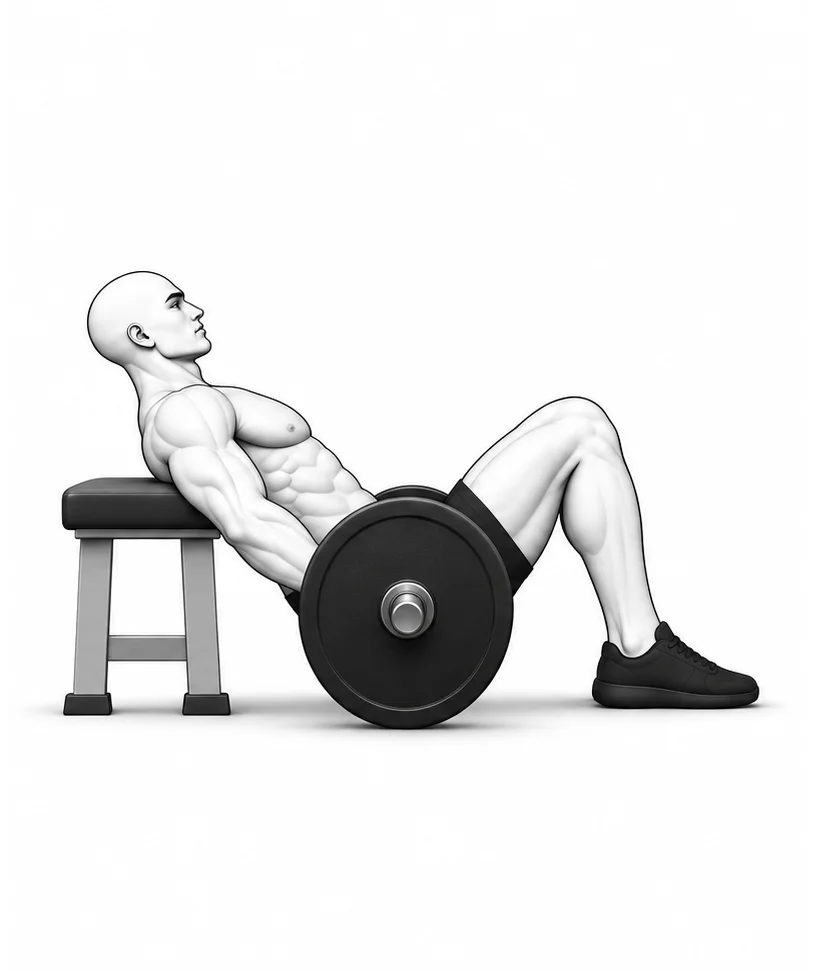
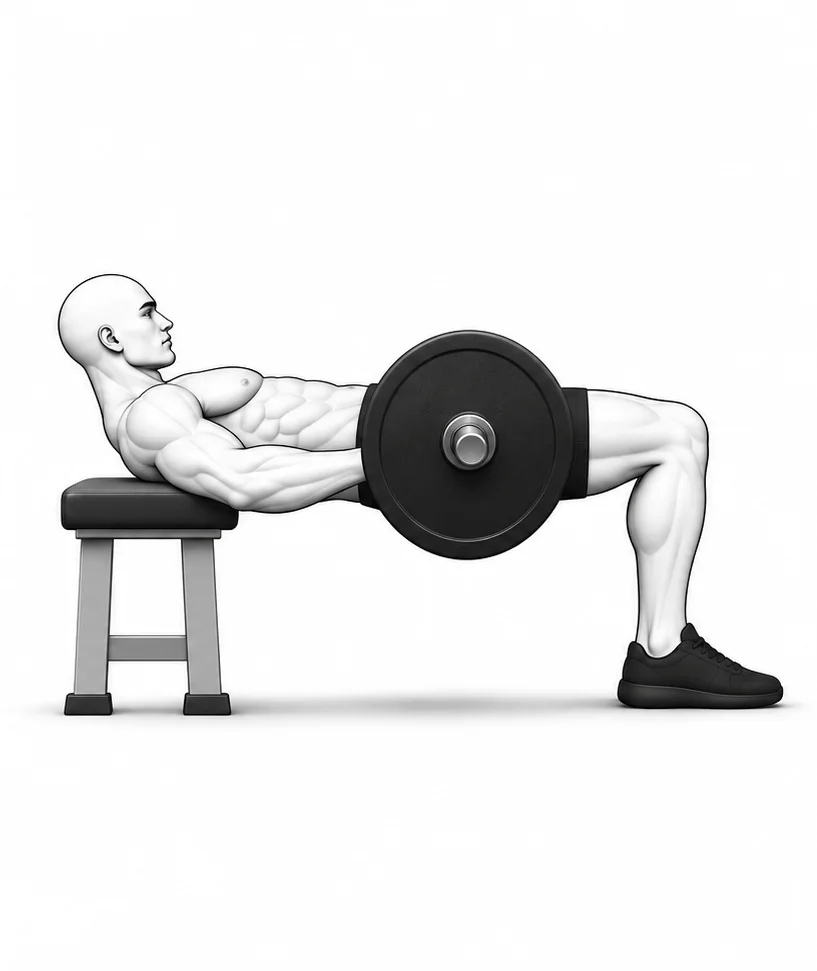
The barbell hip thrust is a glute exercise done with your upper back on a bench and a padded barbell across your hips. You lower your hips towards the floor, then drive them up until your body is flat from your shoulders to your knees.
- TYPE
- Isolation: only the hips move; the knees hold a fixed bend
- PRIMARY MUSCLES
- Glutes
- ALSO WORKING
- Hamstrings, adductors, quads
- EQUIPMENT
- Barbell, a bar pad, and a flat bench against something solid
- DIFFICULTY
- Intermediate: the setup and the bar take practice
Form images
Muscles worked
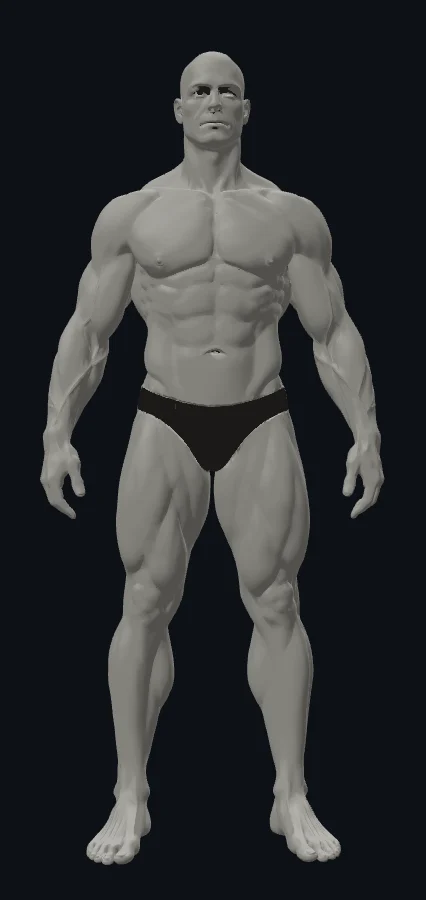
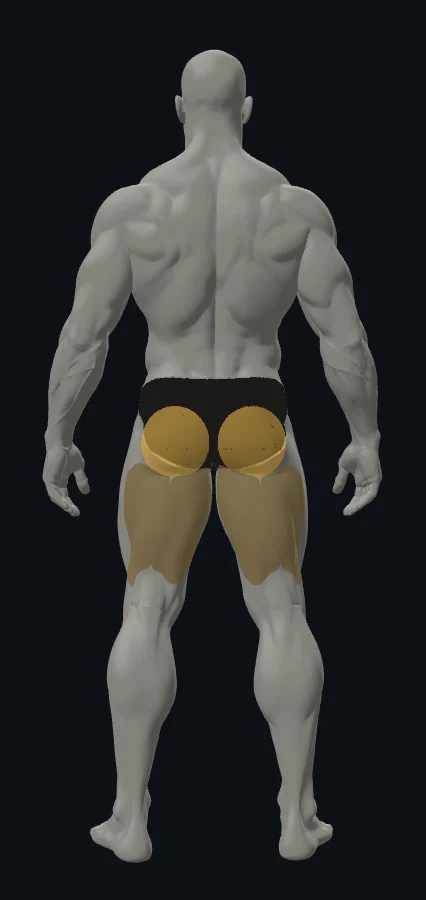
- PRIMARY
- Glutes
- ASSISTING
- Hamstrings, adductors, quads
The hip thrust loads the glutes hardest where they're shortest: at the top, with the hips straight.
- Glutes do most of the work. With 10-rep-max loads, the hip thrust produced much more glute activity than the back squat in trained women [1], and nine weeks of either exercise grew the glutes by similar amounts [2].
- Hamstrings help straighten the hips. They were also more active in the hip thrust than in the squat [1].
- Quads hold the knee angle. Their activity was similar in both lifts [1], but squats grew the thighs more [2].
- Adductors help straighten the hips from the bottom.
Setup
- Brace the bench against a wall or rack so it can't slide back.
- Sit on the floor with the edge of the bench just below your shoulder blades.
- Roll the bar over your legs until it sits in the crease of your hips, with a pad or folded mat under it.
- Plant your feet about hip-width apart, toes slightly out, close enough that your shins will be vertical at the top.
- Hold the bar with both hands, just outside your hips, to keep it from rolling.
How to do it
- Tuck your chin and keep your ribs down.
- Drive through your heels and lift your hips. Your upper back pivots on the edge of the bench.
- Stop when your hips are straight: shoulders, hips and knees in one line.
- Hold for a second with your glutes tight.
- Lower under control until your hips are a few inches off the floor, then start the next rep.
from hips a few inches off the floor to hips straight.
a strong drive up, a 1-second hold, about 2 seconds down.
Common mistakes
Bench slipping back
Your back loses its pivot and the bar shifts mid-rep
Push the bench against a wall or rack before you start.
Bar sitting on your stomach
It's painful, and it tips forward as your hips rise
Roll it right into the hip crease, with a pad under it.
Throwing your head back at the top
Your lower back arches to finish the rep instead of your glutes
Keep your chin tucked so your eyes follow your knees up.
Stopping short of straight hips
You skip the part of the rep where the glutes work hardest
Finish with shoulders, hips and knees in one line.
Make it easier or harder
Variations and alternatives
One glute at a time, with no bar
You want to even out the sides or have no barbell.
Glutes, over a shorter range
You have no bench, or want an easier setup.
The same muscles, on a fixed path
Your gym has one, or setting up the bar is the hard part.
Glutes, plus far more thigh growth [2]
You want one lift for the whole leg.
Hamstrings and glutes at a long stretch
You want to train the glutes where they're lengthened.
Where to fit it into your workout
Place: after your main squat or leg press on a lower-body day, or first on a glute-focused day.
Sets and reps: 3–4 sets of 6–12. Heavy and light loads built similar muscle when sets ended close to failure [3].
Rest: about 2 minutes.
How often: train the glutes at least twice a week [4].
What to pair it with: a squat or leg press for the quads, and a hinge such as the Romanian deadlift for the glutes at long lengths.
Safety
- Use a bar pad or folded mat over your hips, and build the weight up gradually.
- Get out from under the bar by rolling it down your thighs at the end of the set, not by sitting up under it.
- Check with a doctor or physical therapist first if you have an injury, pain or a medical condition, or are pregnant.
- Stop the set if you feel sharp pain, joint pain, dizziness or chest pain. Muscle burn and effort are normal; pain is not.
- This page is general information about exercise technique. It isn't medical advice and doesn't replace advice from a professional who knows your health. See our Terms of Service.
Questions people ask
What is the best glute exercise?
No single lift wins. The hip thrust works the glutes harder in the moment than the squat [1], but over nine weeks the two grew the glutes by similar amounts [2]. Pick the one you can load and progress, or use both.
How long until I see results from hip thrusts?
In the training study, glute growth was measurable on MRI after nine weeks of training twice a week [2]. What you can see in a mirror depends on body fat and how long you keep progressing.
What are good hip thrust alternatives?
The hip thrust machine, the glute bridge, the single-leg hip thrust, and squats or Romanian deadlifts if you want the glutes trained alongside the thighs.
Sources
- 1Contreras B, Vigotsky AD, Schoenfeld BJ, Beardsley C, Cronin J. A comparison of gluteus maximus, biceps femoris, and vastus lateralis electromyographic activity in the back squat and barbell hip thrust exercises. J Appl Biomech. 2015;31(6):452–8.
- 2Plotkin DL, Rodas MA, Vigotsky AD, et al. Hip thrust and back squat training elicit similar gluteus muscle hypertrophy and transfer similarly to the deadlift. Front Physiol. 2023;14:1279170.
- 3Schoenfeld BJ, Grgic J, Ogborn D, Krieger JW. Strength and hypertrophy adaptations between low- vs. high-load resistance training: a systematic review and meta-analysis. J Strength Cond Res. 2017;31(12):3508–23.
- 4Schoenfeld BJ, Ogborn D, Krieger JW. Effects of resistance training frequency on measures of muscle hypertrophy. Sports Med. 2016;46(11):1689–97.