Back Squat
The barbell back squat is a full-body leg lift: you carry a barbell across your upper back, sit down between your feet until your thighs are at or below parallel, and stand back up.
- TYPE
- Compound: works hips, knees and ankles together
- PRIMARY MUSCLES
- Quadriceps, glutes, adductors (inner thighs)
- ALSO WORKING
- Spinal erectors, calves, core
- EQUIPMENT
- Barbell, squat rack with safety arms
- DIFFICULTY
- Beginner, in a rack with safety arms; the goblet squat is an easier start
Form images
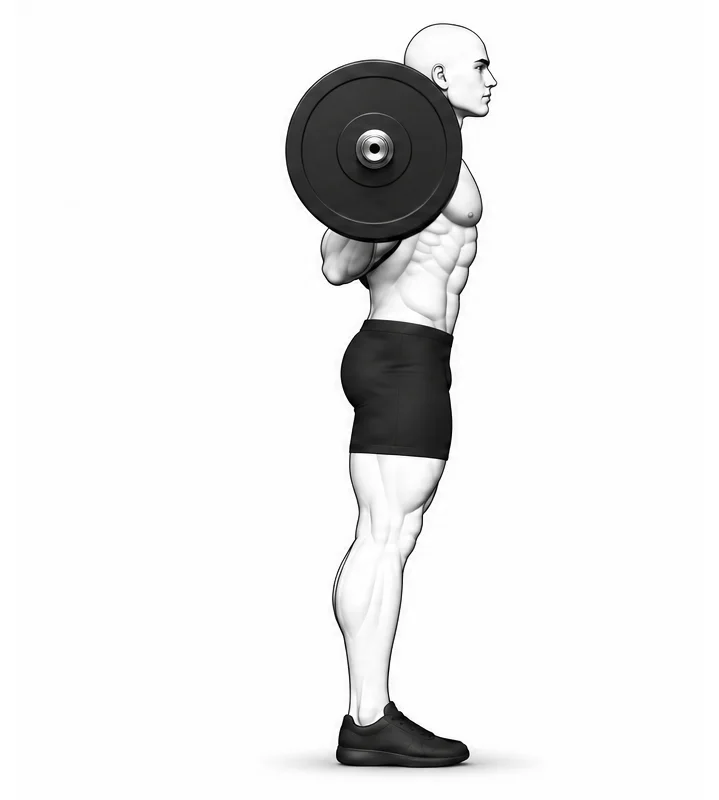
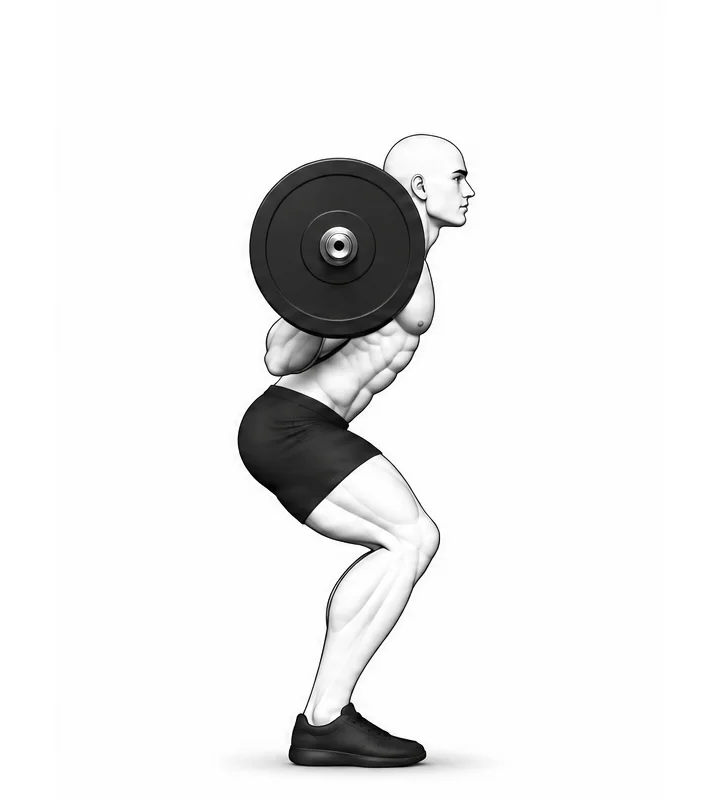
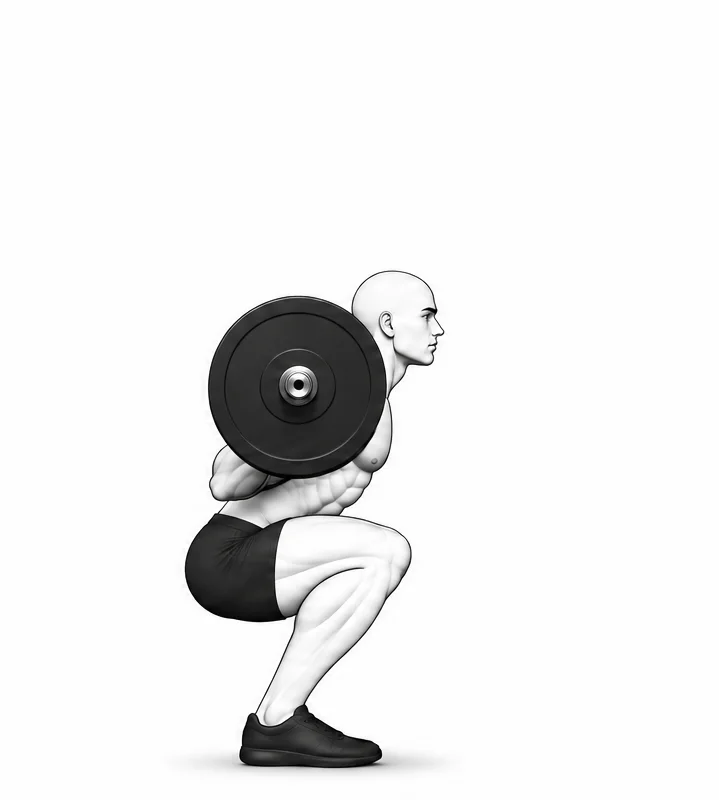
Muscles worked
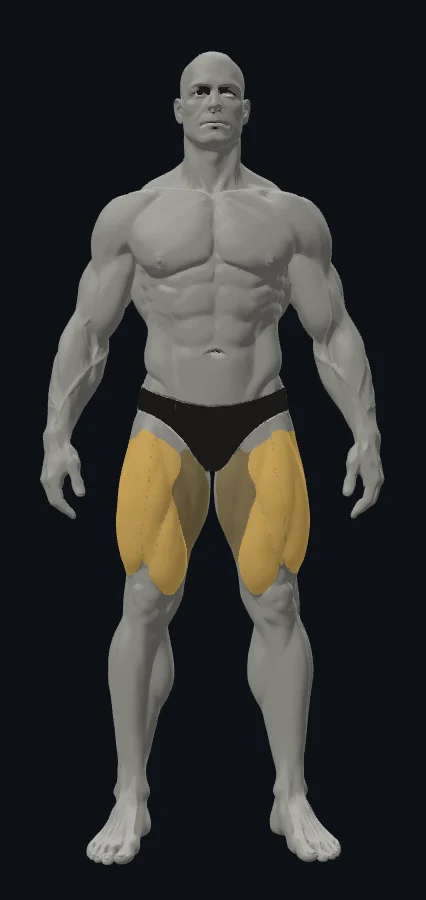
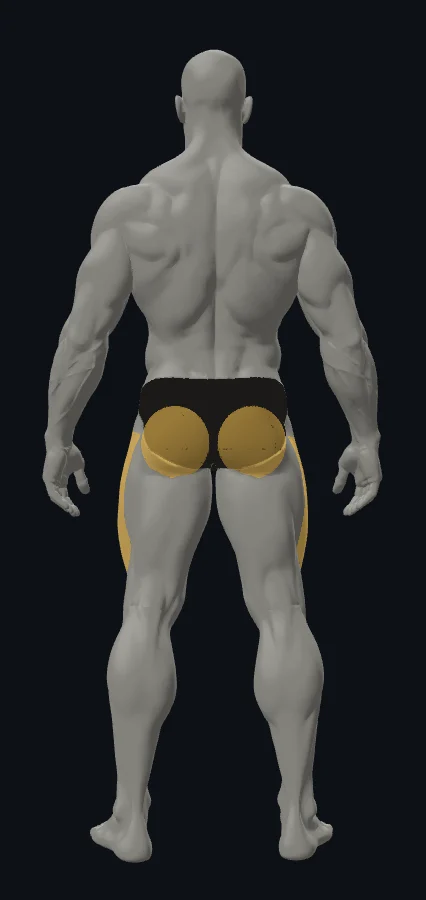
- PRIMARY
- Quadriceps, glutes, adductors (inner thighs)
- ASSISTING
- Spinal erectors, calves, core
The squat is mainly a quadriceps, glute and adductor lift; the hamstrings help far less than people expect.
- Quadriceps straighten the knee, and do the most work getting you out of the bottom.
- Glutes extend the hip as you stand. Squatting to full depth grew them more than half squats did in a 10-week MRI study [3].
- Adductors (inner thighs) are strong hip extensors deep in the squat; they also grew more with full-depth squats [3].
- Spinal erectors hold your back still under the bar rather than move it.
- Hamstrings barely grow from squatting: they lengthen at the hip as they shorten at the knee [3]. Train them with a hinge or leg curl.
Setup
- Set the rack. Bar hooks at about mid-chest height, so you unrack with a slight knee bend, never on tiptoe. Set the safety arms just below your bottom position.
- Grip. Hands just outside your shoulders, thumbs around the bar. Narrower is tighter but needs more shoulder mobility.
- Bar position. Step under and rest the bar on the meaty upper trapezius, below the bony bump at the base of the neck (the high-bar position). Pull your elbows down and back to make a shelf.
- Unrack. Stand straight up, take two or three small steps back, no more.
- Stance. Heels about shoulder-width apart, toes turned out roughly 15–30°. Toe angle doesn't change which muscles work [5], so choose the one that lets your knees follow your toes.
- Check the balance point. The bar should sit over the middle of your foot. You should feel your weight spread across the whole foot, not on the heels or toes.
How to do it
- Breathe and brace. Take a big breath into your belly, then tighten your trunk as if bracing for a punch. Hold it for the whole rep.
- Sit down between your feet. Bend hips and knees at the same time. Let your knees travel forward over your toes and out in line with them; your torso tilts forward to keep the bar over mid-foot.
- Reach depth. Go down until the hip crease is level with or just below the top of the knee, or as deep as you can while your lower back stays neutral.
- Stand up. Drive the floor away through the whole foot. Hips and shoulders rise together, and the bar travels in a straight vertical line.
- Finish tall. Lock out hips and knees, then breathe out at the top before the next rep. Take one new breath per rep.
to at least parallel. Full-depth squats built more glute and adductor muscle than half squats, with similar quadriceps growth [3].
about 2 seconds down, no pause, then stand up with intent. Controlled down, never dropped into the bottom.
Common mistakes
Knees cave inward on the way up
Puts sideways stress through the knee and robs the hips of force [2]
Spread the floor with your feet; knees track over your toes. Drop the weight until they stay there.
Holding the knees back behind the toes
Keeping the shins vertical cut knee torque only modestly (150 → 117 N·m) but raised hip torque about tenfold (28 → 303 N·m), leaning you forward and loading the lower back [4]
Let the knees travel forward over the toes; keep the bar over mid-foot instead.
Bar drifts forward of mid-foot, weight onto the toes
The bar is no longer balanced, so the back has to hold it and the rep often stalls
Keep the whole foot planted. Slow down; film from the side to check.
Lower back rounds at the bottom ("butt wink")
Under load, the spine is the most vulnerable joint in the squat [2]
Stop just above the depth where it rounds, brace harder, and build depth over time.
Make it easier or harder
Holding one dumbbell at your chest teaches the same pattern with a light load and an upright torso. Move to the barbell when you can do 3 sets of 10 with good depth.
Hold the bottom position for 2 seconds before standing. It removes the bounce, so it builds strength out of the hole and exposes weak positions.
Variations and alternatives
Low-bar: more hips; high-bar: more quads
Low-bar sits the bar lower, across the rear shoulders, leaning you further forward. Choose it for heavier loads and more hip work; high-bar for a more upright, quad-heavy squat.
Same muscles, hardest at the bottom
Hold the bottom for 2 seconds before standing. Choose it to build strength out of the bottom and to stop bouncing.
More quads, less lower back
You want a very upright torso and more quads, or your back is the limit.
Quads and glutes, no load on the back
You want to load the legs without loading your back, or no rack is free.
Same muscles, lighter; core holds the weight
You're learning the pattern or training light.
Glutes and quads, one leg at a time
You want one leg at a time, or a free squat rack is the bottleneck.
Where to fit it into your workout
Put it first. As a heavy compound lift, the squat goes at the start of the session, before isolation work like leg extensions or curls. Strength gains are largest for the lifts done first in a session; muscle growth was similar either way [6].
Sets and reps: 3–4 working sets of 6–10 reps suit most people building muscle and strength. Go heavier (3–5 reps) for strength, lighter (10–15) if you're learning.
Rest: 2–3 minutes between sets. Three minutes' rest built more strength and quadriceps muscle than one minute in trained lifters [7].
How often: twice a week. Training a muscle at least twice a week grew it more than once a week [8]. Two squat sessions, or one squat day and one day with a leg press or split squat, both work.
What to pair it with: after squats, add a hamstring lift (Romanian deadlift or leg curl), since the squat barely trains them [3]. Avoid heavy deadlifts on the same day if your lower back is the limit.
Safety
- Always squat inside a rack with the safety arms set just below your bottom position, so you can set a failed rep down.
- If you have a kneecap or posterior cruciate ligament problem, squat to a shallower depth or check with a clinician first: knee forces rise as you squat deeper [5].
- Stop the set if your form breaks down; fatigue degrades squat technique [2].
- Check with a doctor or physical therapist first if you have an injury, pain or a medical condition, or are pregnant.
- Stop the set if you feel sharp pain, joint pain, dizziness or chest pain. Muscle burn and effort are normal; pain is not.
- This page is general information about exercise technique. It isn't medical advice and doesn't replace advice from a professional who knows your health. See our Terms of Service.
Questions people ask
How deep should a squat be?
To at least parallel: the hip crease level with the top of the knee. Going deeper builds more glute and adductor muscle [3], as long as your lower back stays neutral. One older review favoured parallel over very deep squats for knee safety [1], so if deep squats bother your knees, parallel is plenty.
What muscles do squats work?
Mostly the quadriceps, glutes and adductors, with the back and calves holding position. The hamstrings do much less than most people think [3].
Should your knees go past your toes when you squat?
Yes, for most people. Holding them back moved the load to the hips and lower back far more than it spared the knees [4].
What are the different types of squats?
The main ones are the high-bar and low-bar back squat, the front squat, the goblet squat and the split squat. See Variations and alternatives above for when to choose each.
Sources
- 1Escamilla RF. Knee biomechanics of the dynamic squat exercise. Med Sci Sports Exerc. 2001;33(1):127–41. pubmed.ncbi.nlm.nih.gov/11194098/
- 2Schoenfeld BJ. Squatting kinematics and kinetics and their application to exercise performance. J Strength Cond Res. 2010;24(12):3497–506. pubmed.ncbi.nlm.nih.gov/20182386/
- 3Kubo K, Ikebukuro T, Yata H. Effects of squat training with different depths on lower limb muscle volumes. Eur J Appl Physiol. 2019;119(9):1933–42. pubmed.ncbi.nlm.nih.gov/31230110/
- 4Fry AC, Smith JC, Schilling BK. Effect of knee position on hip and knee torques during the barbell squat. J Strength Cond Res. 2003;17(4):629–33. pubmed.ncbi.nlm.nih.gov/14636100/
- 5Escamilla RF, et al. Effects of technique variations on knee biomechanics during the squat and leg press. Med Sci Sports Exerc. 2001;33(9):1552–66. pubmed.ncbi.nlm.nih.gov/11528346/
- 6Nunes JP, et al. What influence does resistance exercise order have on muscular strength gains and muscle hypertrophy? Eur J Sport Sci. 2021;21(2):149–57. pubmed.gov/32077380/
- 7Schoenfeld BJ, et al. Longer interset rest periods enhance muscle strength and hypertrophy in resistance-trained men. J Strength Cond Res. 2016;30(7):1805–12. pubmed.ncbi.nlm.nih.gov/26605807/
- 8Schoenfeld BJ, Ogborn D, Krieger JW. Effects of resistance training frequency on measures of muscle hypertrophy. Sports Med. 2016;46(11):1689–97. pubmed.ncbi.nlm.nih.gov/27102172/