Goblet Squat
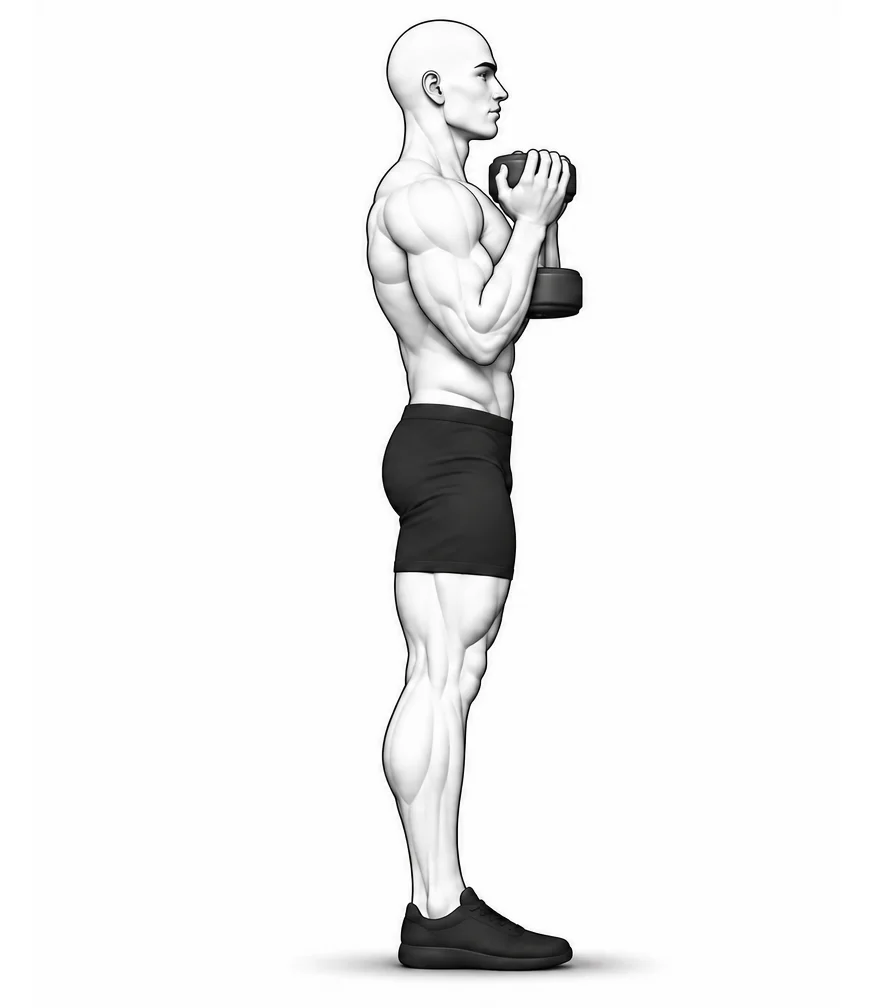
The goblet squat is a squat with one weight held at your chest. The weight in front helps you sit down between your knees with your chest up, which makes it the easiest way to learn the squat.
- TYPE
- Compound: works hips, knees and ankles together
- PRIMARY MUSCLES
- Quads
- ALSO WORKING
- Glutes, adductors (inner thighs), upper back to hold the weight
- EQUIPMENT
- One kettlebell, or one dumbbell held upright
- DIFFICULTY
- Beginner
Form images
Muscles worked
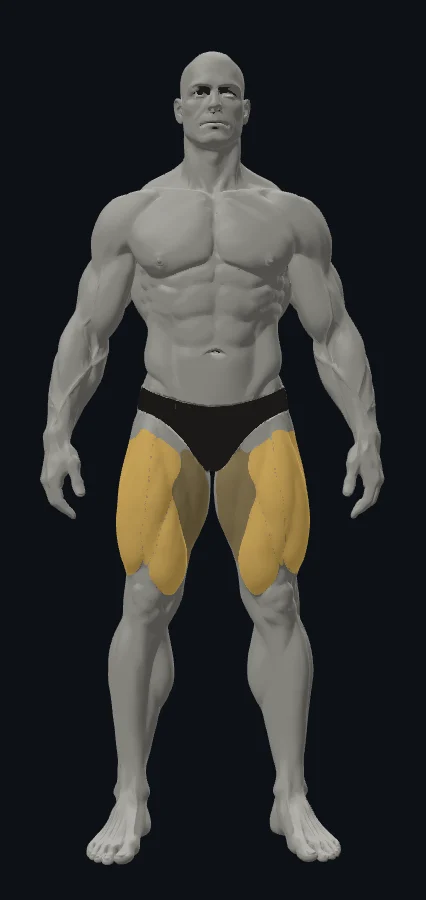
- PRIMARY
- Quads
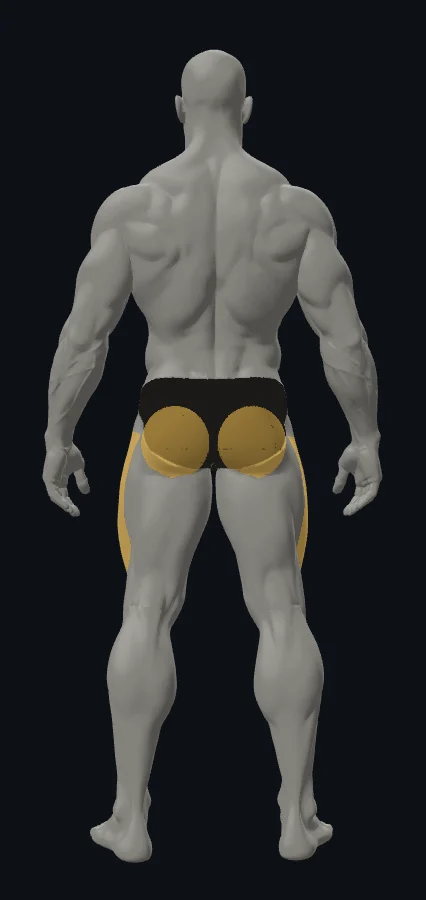
- ASSISTING
- Glutes, adductors (inner thighs), upper back to hold the weight
The goblet squat is mainly a quad exercise, with the glutes and adductors helping as you stand up from the bottom.
- Quads straighten your knees as you stand up. They do most of the work.
- Glutes and adductors straighten your hips. Squatting deep grew both more than a half squat did, while the quads grew similarly at either depth [1].
- Upper back and core hold the weight against your chest and stop your torso folding forward.
Setup
- Pick up the weight. Hold a kettlebell by the horns, or a dumbbell upright by one end, cupped in both hands.
- Hold it high. Rest it against your chest just under your chin, elbows pointing down.
- Set your feet. Stand with your feet a little wider than your hips, toes turned slightly out.
- Brace. Take a breath into your belly and tighten your trunk before each rep.
How to do it
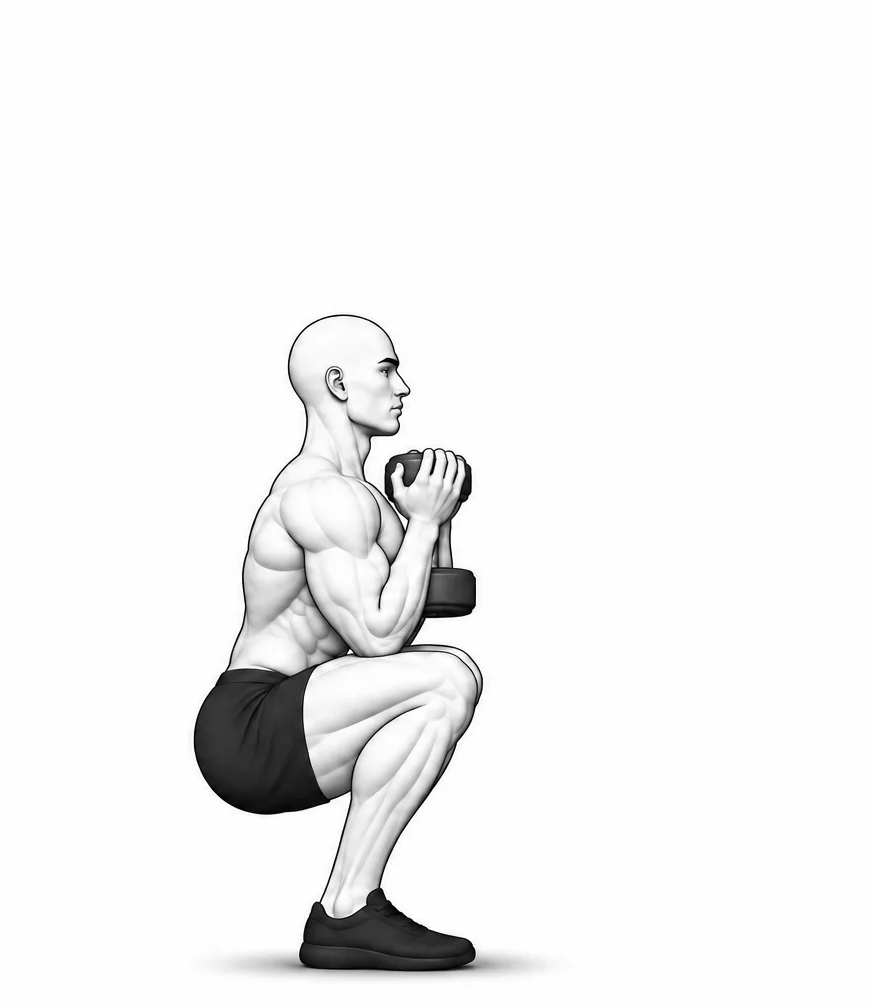
- Sit down between your heels. Bend your hips and knees together, keeping your chest up.
- Push your knees out so they follow the line of your toes.
- Go as deep as you can with your heels down and back flat. For most people that's with the hips below the knees.
- Stand up by pushing the floor away, keeping the weight tight to your chest.
- Finish tall with your hips and knees straight.
from standing to as deep as you can go with your heels down and your back flat.
about 2 seconds down, no bounce at the bottom, a steady drive up.
Common mistakes
Heels lifting
Your weight shifts onto your toes and you lose balance
Sit back between your heels and keep the whole foot on the floor.
Knees caving in
Your knees track inside your toes
Push your knees out over your toes on the way up.
Weight drifting away from the chest
Your torso folds forward and your back rounds
Keep the weight touching your chest for the whole rep.
Stopping high
A half squat trained the glutes and adductors less than a deep one [1]
Go as deep as you can control.
Make it easier or harder
Squat down to a bench behind you, touch it lightly and stand up. It teaches depth and gives you a target.
Once you can goblet squat a heavy dumbbell for 10 clean reps, the barbell lets you keep adding load.
Variations and alternatives
Same muscles, with a set depth
You're still learning how deep to go.
Quads, glutes and adductors, with far more load
The heaviest weight you can hold at your chest is no longer a challenge.
Quads, with your back supported
You want heavy quad work without balancing a weight.
Each leg on its own
You want single-leg work, or one side is weaker.
Where to fit it into your workout
First on leg day while you're learning to squat; later, after the back squat or leg press as lighter extra work.
Sets and reps: 3 sets of 8–15 reps. Heavy and light loads built similar muscle when the sets ended close to failure [2], so higher reps are fine when your heaviest weight runs out.
Rest: 90 seconds to 2 minutes.
How often: train your legs at least twice a week; twice weekly beat once a week for muscle growth [3].
What to pair it with: a hip hinge such as the stiff-legged dumbbell deadlift, so the hamstrings are trained too.
Safety
- Set the weight down with control at the end of a set; don't drop it from your chest.
- Keep your heels down. If you can't, stop the rep where your heels start to lift.
- Check with a doctor or physical therapist first if you have an injury, pain or a medical condition, or are pregnant.
- Stop the set if you feel sharp pain, joint pain, dizziness or chest pain. Muscle burn and effort are normal; pain is not.
- This page is general information about exercise technique. It isn't medical advice and doesn't replace advice from a professional who knows your health. See our Terms of Service.
Questions people ask
What is the proper form for a goblet squat?
Hold the weight at your chest, sit down between your heels with your chest up and your elbows inside your knees, go as deep as you can with your heels down, then push the floor away to stand.
What are the benefits of goblet squats?
The weight in front keeps your torso upright, so it's the easiest way to learn the squat pattern, and it needs only one kettlebell or dumbbell.
How deep should a goblet squat be?
As deep as you can go with your heels down and your back flat; for most people that's with the hips below the knees. Deeper squats grew the glutes and adductors more than half squats [1].
What muscles are worked during a goblet squat?
Mainly the quads, with the glutes and adductors, and your upper back and core holding the weight.
Sources
- 1Kubo K, Ikebukuro T, Yata H. Effects of squat training with different depths on lower limb muscle volumes. Eur J Appl Physiol. 2019;119(9):1933–42.
- 2Schoenfeld BJ, Grgic J, Ogborn D, Krieger JW. Strength and hypertrophy adaptations between low- vs. high-load resistance training: a systematic review and meta-analysis. J Strength Cond Res. 2017;31(12):3508–23.
- 3Schoenfeld BJ, Ogborn D, Krieger JW. Effects of resistance training frequency on measures of muscle hypertrophy. Sports Med. 2016;46(11):1689–97.