Chest-Supported Row
The chest-supported row is a dumbbell row done lying face down on an incline bench. With the bench holding your chest, you let the dumbbells hang, then pull them up beside your ribs. Your torso can't move, so your back does the pulling and your lower back gets a rest.
- TYPE
- Compound: works shoulders and elbows together
- PRIMARY MUSCLES
- Middle and lower trapezius, rhomboids, lats, rear delts
- ALSO WORKING
- Biceps
- EQUIPMENT
- Two dumbbells and an adjustable incline bench
- DIFFICULTY
- Beginner
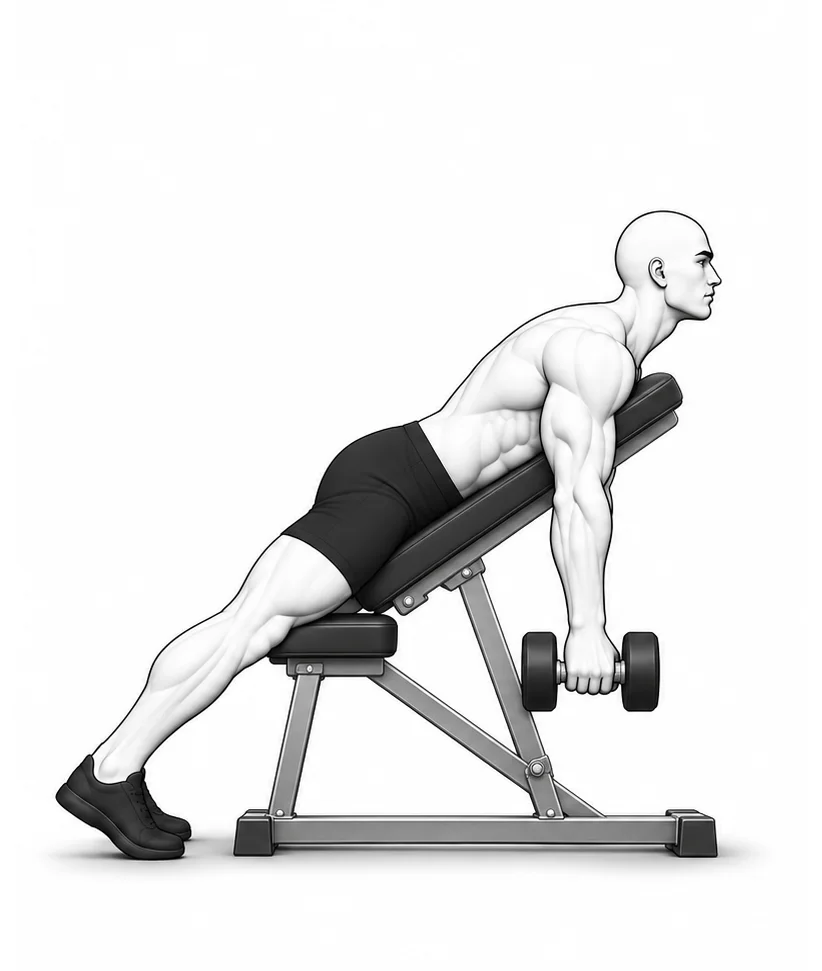
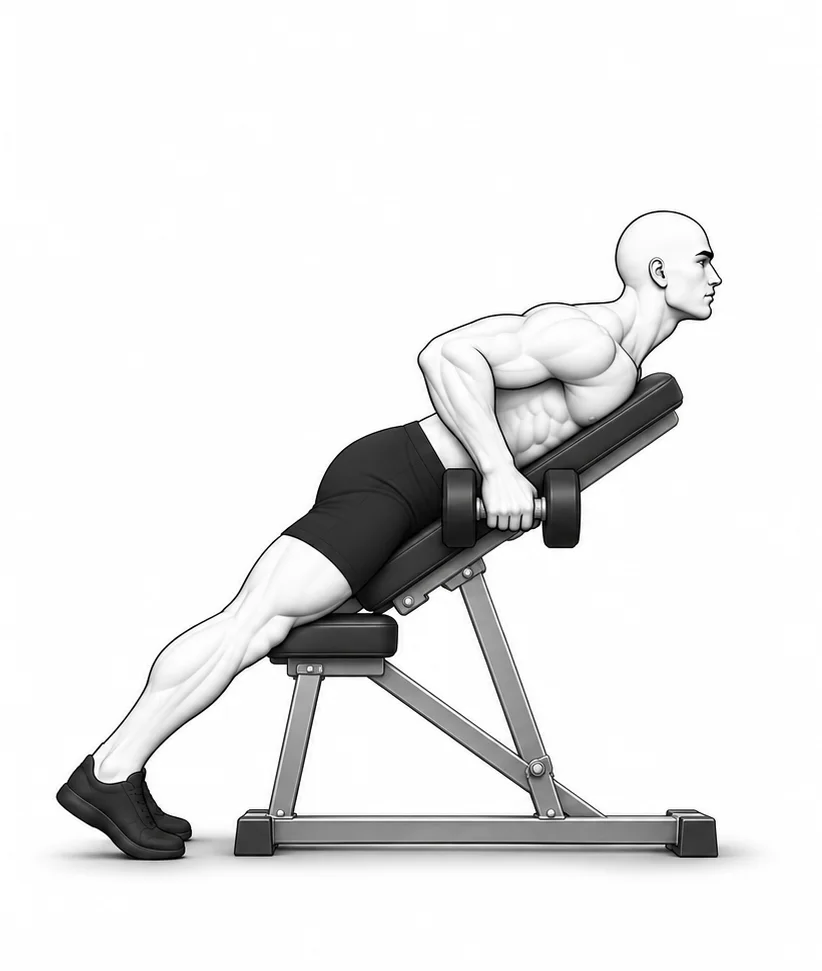
Form images
Muscles worked
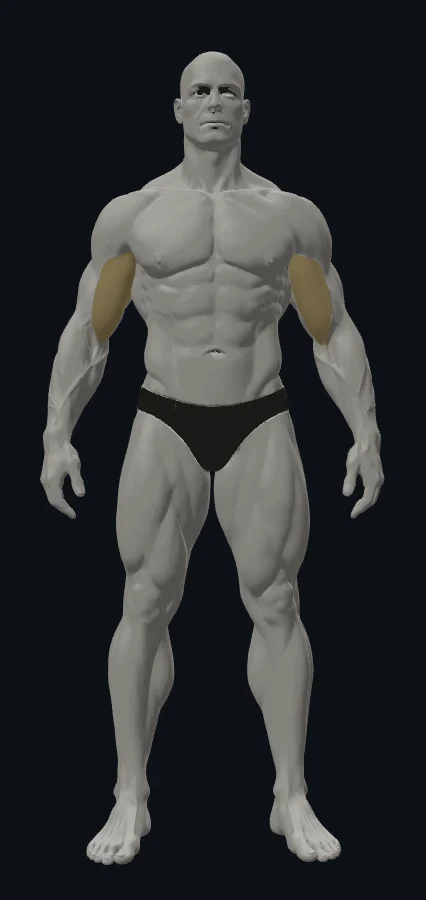
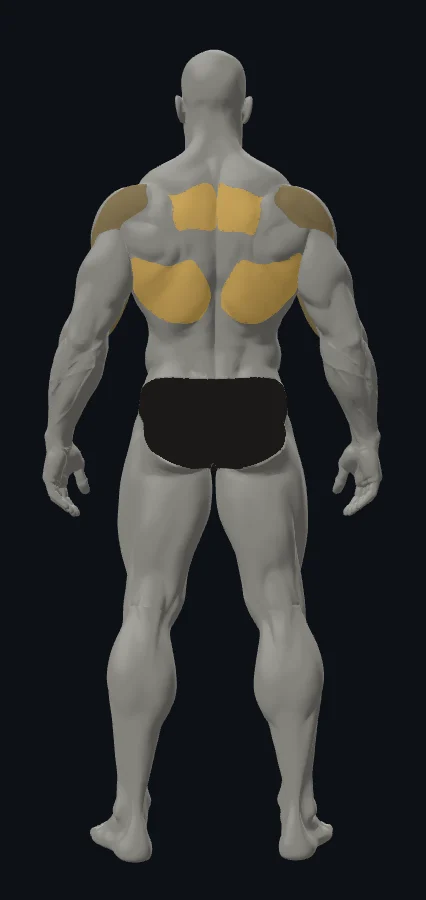
- PRIMARY
- Middle and lower trapezius, rhomboids, lats, rear delts
- ASSISTING
- Biceps
This row trains the upper and middle back while the bench holds you still.
- Middle and lower trapezius and rhomboids squeeze your shoulder blades together, which is the main job here.
- Lats pull your upper arms back, most when your elbows stay close to your sides.
- Rear delts draw your arms back, more so if you let your elbows flare out.
- Biceps bend your elbows.
- Lower back: it does almost nothing, because the bench holds your torso. Of three rows one study compared, the standing bent-over row put the most load on the lower spine [1]. The chest-supported row takes that position away.
Setup
- Set the bench to 30–45 degrees. A lower angle makes the row more horizontal.
- Place a dumbbell on each side of the bench, near the front.
- Lie face down with your chest on the pad and your chin just past its top edge. Plant your toes or feet on the floor behind you.
- Pick up the dumbbells and let them hang straight down, palms facing each other.
How to do it
- Draw your shoulder blades together to start each rep.
- Row the dumbbells up beside your ribs, elbows going back past your torso.
- Pause for a moment at the top.
- Lower them until your arms hang straight, letting your shoulder blades spread.
- Keep your chest on the pad throughout; your legs only hold you in place.
from arms hanging straight down with the shoulder blades apart, to the dumbbells beside your ribs.
about 1 second up, a short pause, about 2–3 seconds down.
Common mistakes
Lifting your chest off the bench
You use your back and legs to heave the weight
Choose dumbbells you can row with your chest flat on the pad.
Bench too steep
The row turns into a shrug, pulled upward instead of back
Lower the bench to 30–45 degrees.
Stopping short at the bottom
Your shoulder blades never spread, so the back muscles don't stretch
Let the dumbbells hang until your arms are straight.
Craning the neck up
It strains your neck as the set gets hard
Keep your head in line with the bench, chin just past the edge.
Make it easier or harder
Use it before you go up in weight.
Variations and alternatives
Same muscles, on a fixed path that's easy to load heavy
Your gym has the machine.
More rear delts and upper trapezius
You want to row with your palms facing back and elbows out.
Lats and upper back, one side at a time, with your trunk working
You want your trunk to resist twisting as you row.
Same back muscles, plus your lower back holding you upright
You want to train the back and trunk together.
More lats, in a vertical pull
You want to pull down instead of back.
Where to fit it into your workout
Place: early on a back or pull day. It also suits the end of a session, because your lower back doesn't have to work.
Sets and reps: 3 or 4 sets of 8–15 reps. Light and heavy loads built similar muscle when the sets ended close to failure [2].
Rest: 90 seconds to 2 minutes.
How often: back on two or more days a week [3].
What to pair it with: the incline dumbbell press, using the same bench and dumbbells.
Safety
- Lock the bench's angle before you lie on it; check the pin is fully in.
- Set the dumbbells down at the end of the set before you stand up, rather than climbing off holding them.
- Check with a doctor or physical therapist first if you have an injury, pain or a medical condition, or are pregnant.
- Stop the set if you feel sharp pain, joint pain, dizziness or chest pain. Muscle burn and effort are normal; pain is not.
- This page is general information about exercise technique. It isn't medical advice and doesn't replace advice from a professional who knows your health. See our Terms of Service.
Questions people ask
What muscles does the chest-supported row work?
The middle and lower trapezius, rhomboids, lats and rear delts, with the biceps helping. The lower back does very little.
What equipment do I need?
Two dumbbells and an adjustable bench you can set to an incline. Many gyms also have a chest-supported row machine; see the variation above.
Chest-supported row or seated cable row?
Both train the same back muscles. The chest-supported row takes your lower back out of it. The bent-over row, where your back holds you up, put the most load on the lower spine of the rows one study measured [1]. Choose the cable row when you also want your trunk to work.
What are the benefits?
You can push a set hard without your lower back tiring first, and the bench stops you from swinging the weight.
Sources
- 1Fenwick CMJ, Brown SHM, McGill SM. Comparison of different rowing exercises: trunk muscle activation and lumbar spine motion, load, and stiffness. J Strength Cond Res. 2009;23(2):350–8.
- 2Schoenfeld BJ, Grgic J, Ogborn D, Krieger JW. Strength and hypertrophy adaptations between low- vs. high-load resistance training: a systematic review and meta-analysis. J Strength Cond Res. 2017;31(12):3508–23.
- 3Schoenfeld BJ, Ogborn D, Krieger JW. Effects of resistance training frequency on measures of muscle hypertrophy. Sports Med. 2016;46(11):1689–97.