One-Arm Dumbbell Row
The one-arm dumbbell row trains your back one side at a time. With one hand and one knee on a bench, you pull a dumbbell from arm's length up to your hip, then lower it. The other side of your body holds you square while you lift.
- TYPE
- Compound: works shoulders and elbows together
- PRIMARY MUSCLES
- Lats, middle trapezius, rhomboids
- ALSO WORKING
- Rear delts, biceps, the trunk muscles that stop you twisting
- EQUIPMENT
- One dumbbell and a flat bench
- DIFFICULTY
- Beginner
Form images
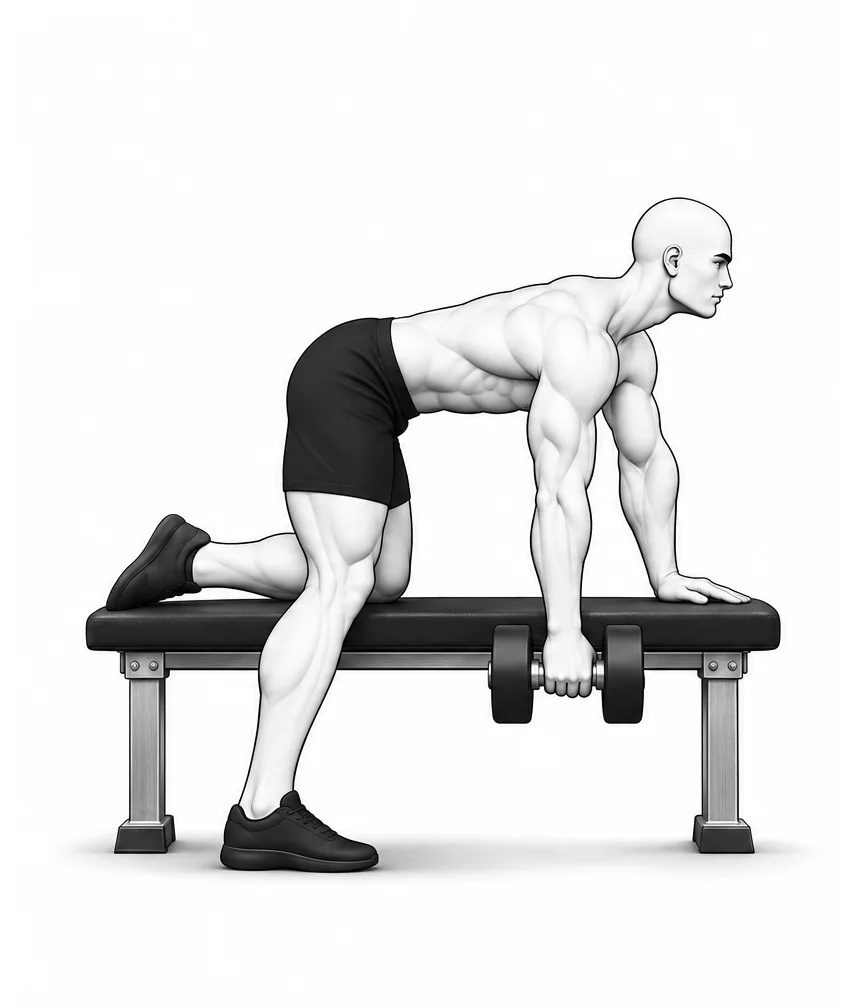
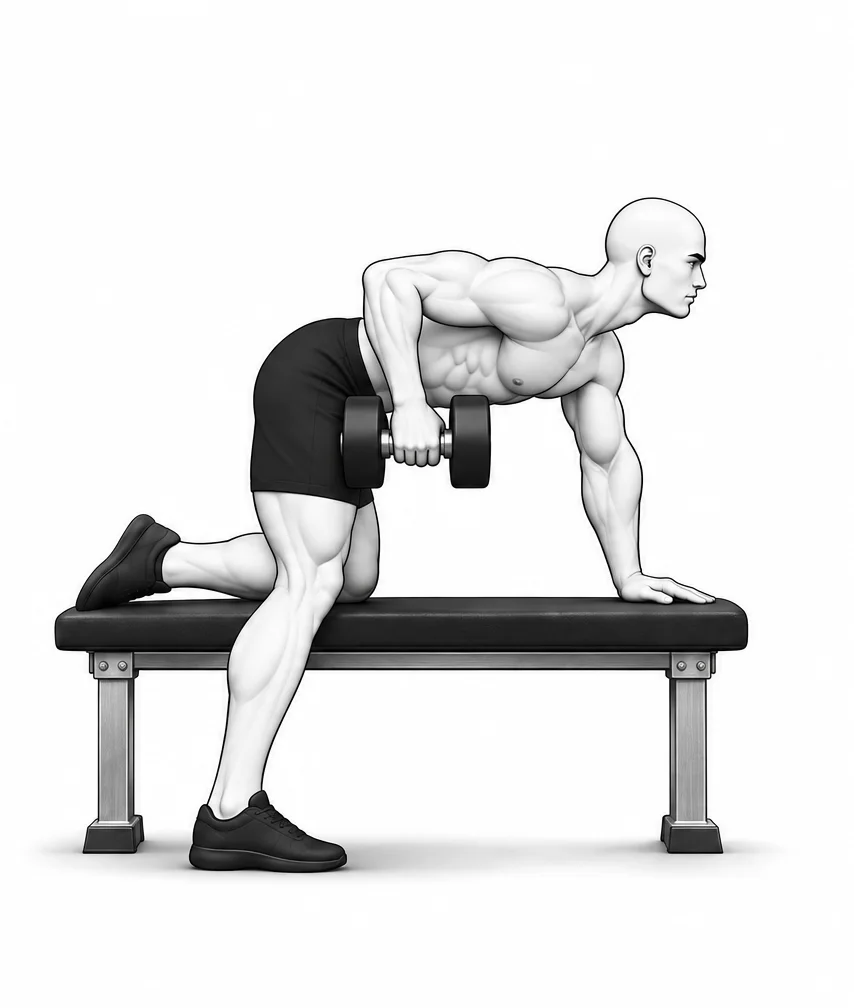
Muscles worked
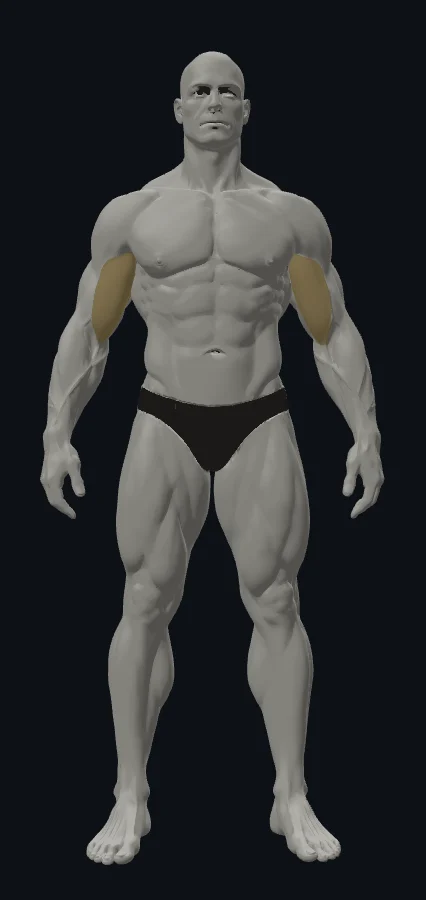
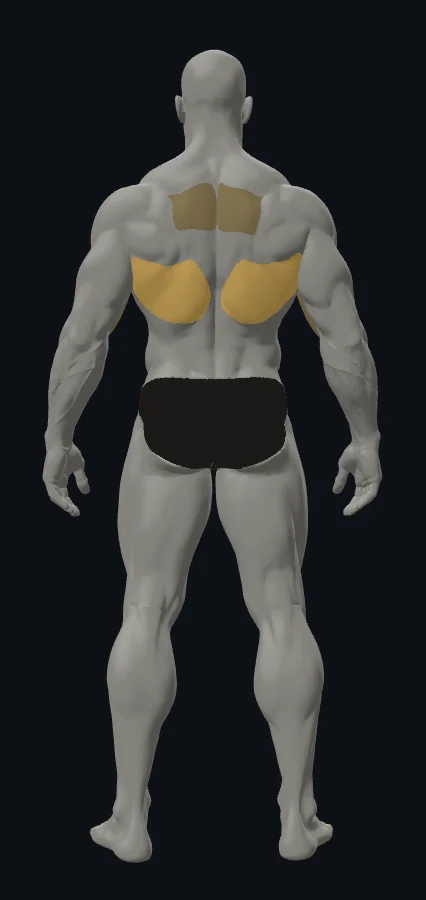
- PRIMARY
- Lats, middle trapezius, rhomboids
- ASSISTING
- Rear delts, biceps, the trunk muscles that stop you twisting
The one-arm row is a back exercise with a trunk job added.
- Lats pull the elbow back towards your hip. A path to the hip, not to the chest, keeps them working.
- Middle trapezius and rhomboids pull the shoulder blade towards your spine at the top.
- Rear delts help draw the arm back.
- Biceps bend the elbow.
- Trunk: a weight on one side tries to rotate you. In one study, a standing one-arm row challenged the trunk's resistance to twisting [1], and your trunk does that job here too.
Setup
- Put the dumbbell beside the bench, so you don't have to round your back to pick it up from far away.
- Place one knee and the same-side hand on the bench: hand under your shoulder, knee under your hip.
- Plant the other foot on the floor, a little out to the side, for a wide base.
- Pick up the dumbbell and let it hang. Your back is flat and close to level with the floor.
How to do it
- Let the shoulder drop towards the floor at the bottom, so your back stretches.
- Pull your elbow up and back towards your hip, keeping it close to your side.
- Stop when your elbow passes your torso, with the dumbbell beside your hip.
- Lower it all the way until your arm is straight and your shoulder hangs.
- Finish every rep on one side, then swap. Start with your weaker side and match its reps on the other.
from a straight arm with the shoulder stretched towards the floor, to the elbow just past your torso.
a smooth pull, a short pause at the hip, about 2 seconds down.
Common mistakes
Twisting open to lift the weight
Your trunk rotates instead of resisting, and the back muscles do less
Keep both hips and shoulders level with the floor; lighten the dumbbell if you can't.
Jerking the weight up
Momentum moves it, not your back
Start each rep from a still hang and pull smoothly.
Rowing to the chest
The path cuts out the lats, and the upper arm and shoulder take more of the load
Aim the elbow at your hip pocket.
Rounding the back
Your spine bends under load with nothing supporting it
Keep the hand on the bench under your shoulder and your back flat.
Make it easier or harder
Brace one hand on a rack or bench in a split stance, with no knee down, so your trunk has more to hold.
Variations and alternatives
Same back muscles, more trunk work
You have no bench, or you want your trunk to hold you.
Same back muscles, less trunk work
You want to lie chest-down on an incline bench and focus on the pull.
Upper back on both sides at once, no trunk work
You want both arms and maximum stability.
Middle back on both sides, with a constant cable pull
You want a two-arm row with even resistance through the range.
Where to fit it into your workout
Place: on a back or pull day, after your first pull (a pulldown or assisted pull-up).
Sets and reps: 3 sets of 8–12 reps on each side. Light and heavy loads built similar muscle when the sets ended close to failure [2].
Rest: go straight from one side to the other, then rest about 90 seconds.
How often: back on two or more days a week [3].
What to pair it with: the dumbbell bench press, so one pair of dumbbells covers both a push and a pull.
Safety
- Keep the supporting hand under your shoulder and your back flat; a rounded back under a heavy dumbbell loads your spine.
- Set the dumbbell down beside the bench at the end of the set rather than dropping it.
- Check with a doctor or physical therapist first if you have an injury, pain or a medical condition, or are pregnant.
- Stop the set if you feel sharp pain, joint pain, dizziness or chest pain. Muscle burn and effort are normal; pain is not.
- This page is general information about exercise technique. It isn't medical advice and doesn't replace advice from a professional who knows your health. See our Terms of Service.
Questions people ask
What muscles does the one-arm dumbbell row work?
Mainly the lats, middle trapezius and rhomboids, with the rear delts and biceps helping. Your trunk also works to stop you twisting [1].
Can I do it without a bench?
Yes. Stand in a split stance, lean forward with your free hand on a rack, sturdy chair or your front thigh, and row. See the standing variation above.
Is it better standing or on a bench?
On a bench, the support lets you focus on the pull and usually lift more. Standing gives your trunk more work. Both train the same back muscles.
Can I do it at home?
Yes. One dumbbell and a bench, chair or sofa arm to lean on is enough.
Sources
- 1Fenwick CMJ, Brown SHM, McGill SM. Comparison of different rowing exercises: trunk muscle activation and lumbar spine motion, load, and stiffness. J Strength Cond Res. 2009;23(2):350–8.
- 2Schoenfeld BJ, Grgic J, Ogborn D, Krieger JW. Strength and hypertrophy adaptations between low- vs. high-load resistance training: a systematic review and meta-analysis. J Strength Cond Res. 2017;31(12):3508–23.
- 3Schoenfeld BJ, Ogborn D, Krieger JW. Effects of resistance training frequency on measures of muscle hypertrophy. Sports Med. 2016;46(11):1689–97.