Incline Bench Press
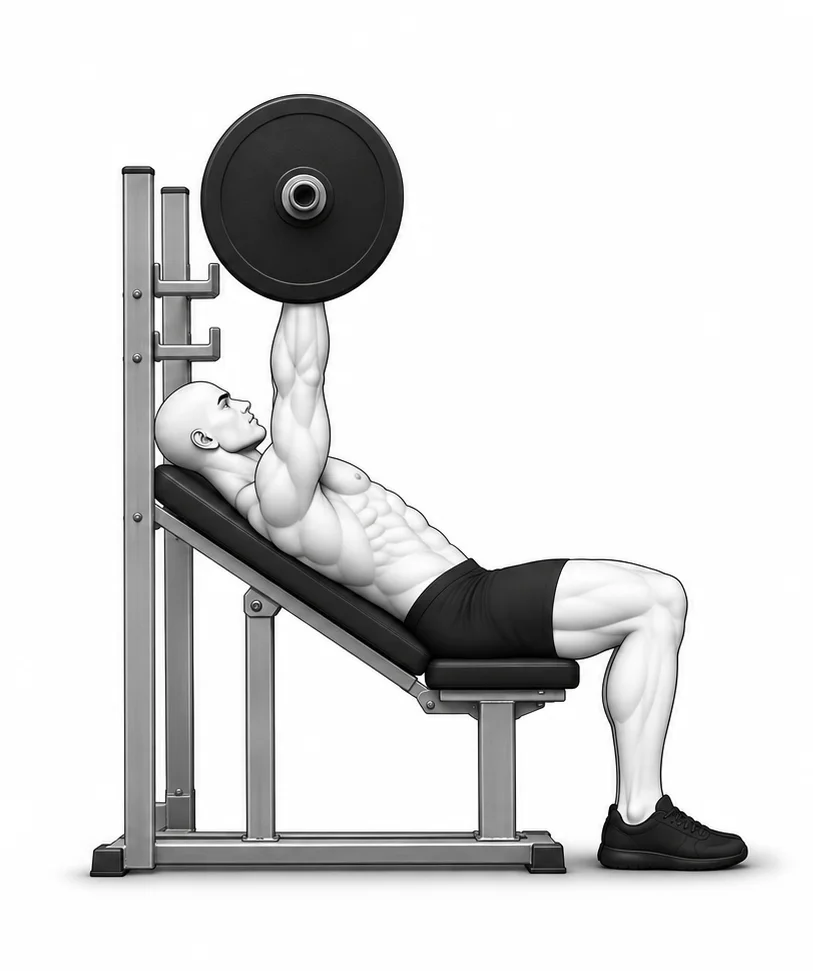
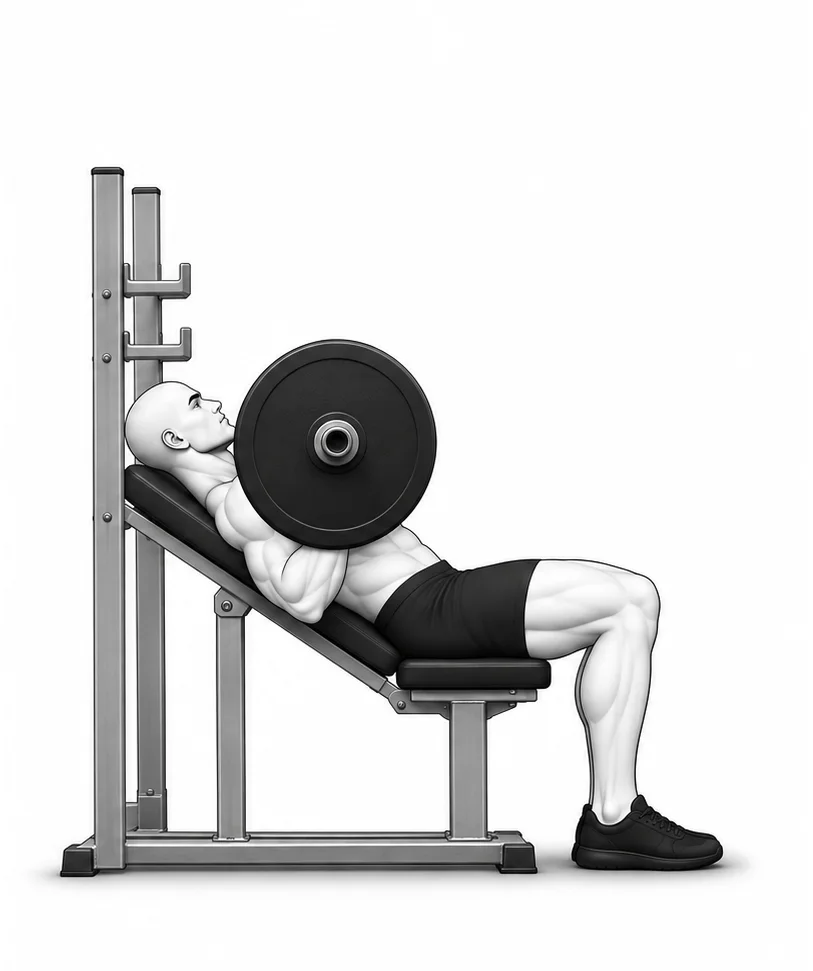
The incline bench press is a barbell press on a bench tilted up at about 30 degrees. The bar comes down to the top of your chest, just under your collarbones, which puts more of the work on the upper chest than a flat bench does.
- TYPE
- Compound: works shoulders and elbows together
- PRIMARY MUSCLES
- Upper chest (clavicular pectoralis major)
- ALSO WORKING
- Front delts, triceps, the rest of the chest
- EQUIPMENT
- Barbell and an incline bench with uprights; a spotter for heavy sets
- DIFFICULTY
- Intermediate: learn the flat bench press first
Form images
Muscles worked
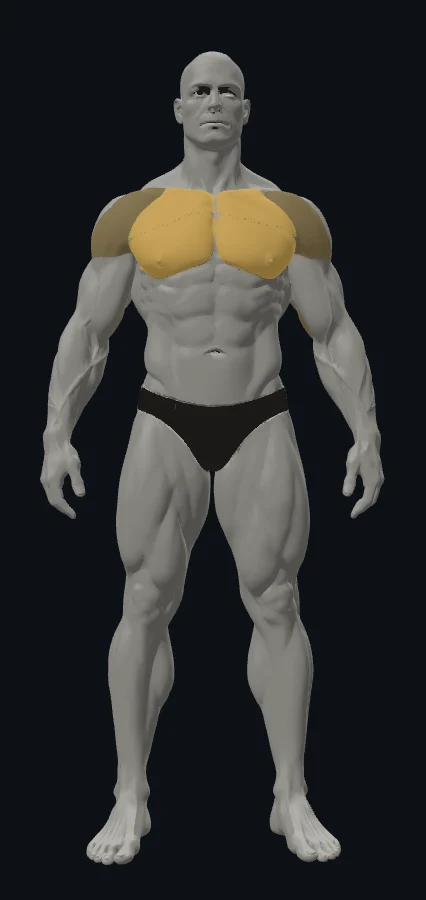
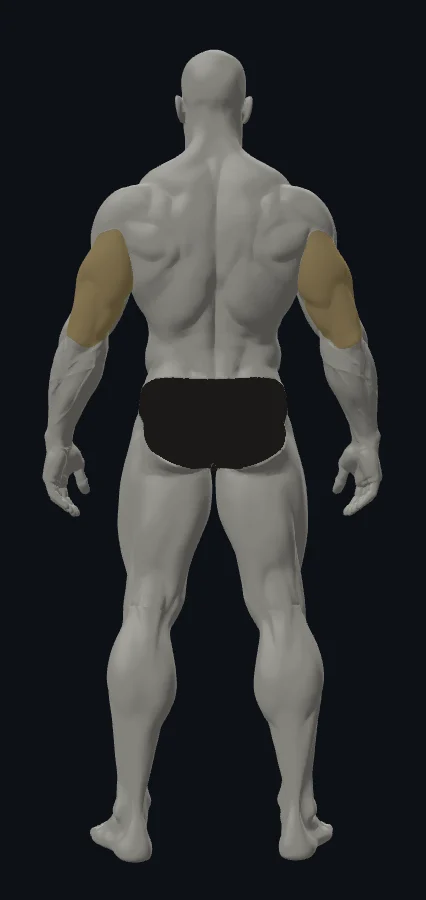
- PRIMARY
- Upper chest (clavicular pectoralis major)
- ASSISTING
- Front delts, triceps, the rest of the chest
Tilting the bench moves the work up the chest and onto the front of the shoulders. About 30 degrees gets the most from the upper chest before the shoulders take over.
- Upper chest works hardest at about 30 degrees. In trained lifters, its activity peaked at 30°; past 45° the front delts did more and the chest did less [1].
- Middle and lower chest work less than on a flat bench. Their activity was highest at 0° [1].
- Front delts help raise the arms, and do more the steeper the bench [1].
- Triceps lock the bar out. Their activity was about the same at every angle tested [1].
Setup
- Set the back pad to about 30 degrees, or the first notch above it. Check the pin is locked.
- Sit so the bar is over your eyes when you lie back. Too far forward and you'll hit the uprights; too far back and you'll press from behind your head.
- Feet flat on the floor and wide enough to stop you sliding down the seat.
- Shoulder blades back and down into the pad, with your hips and upper back touching it.
- Take a grip just wider than your shoulders, thumbs around the bar.
- Unrack with straight arms and bring the bar out until it's over your shoulders, not your face.
How to do it
- Breathe in and brace before you lower the bar.
- Lower the bar to the top of your chest, just under your collarbones. It travels almost straight down.
- Elbows at about 45 degrees to your body, under the bar.
- Touch lightly. No bounce; your shoulder blades stay pinned.
- Press straight up until your arms are straight and the bar is back over your shoulders.
from straight arms to the bar touching the top of your chest.
about 2 seconds down, a light touch, then a strong press.
Common mistakes
Bench set at 45° or more
Your front delts take over and the chest does less [1]
Drop the pad to about 30 degrees.
Lowering to the middle of the chest, as on a flat bench
On an incline, the bar ends up in front of your shoulders and drifts forward on the way up
Touch the top of your chest, just below the collarbones.
Hips lifting off the seat to push harder
It flattens your back towards a flat bench and takes the upper chest out of it
Keep your hips down; use a lighter weight if you can't.
Elbows flared straight out
It strains the front of the shoulder
Keep your elbows at about 45 degrees, under the bar.
Make it easier or harder
Variations and alternatives
The middle chest, with less shoulder
The 30-degree version bothers your shoulders.
The same muscles, with a fixed bar path
You train alone and want a bar you can rack at any point.
The same muscles, each arm on its own
You want a longer stretch or your gym has no incline rack.
Middle and lower chest [1]
You want the flat version, which usually moves more weight.
Front delts
You want shoulder work, not chest work.
Where to fit it into your workout
Place: first on an upper-chest day, while you're fresh; otherwise straight after a flat press.
Sets and reps: 2–4 sets of 6–12. Heavy and light loads built similar muscle when sets ended close to failure [3].
Rest: 2–3 minutes between heavy sets.
How often: train the chest at least twice a week [4]. The incline can be one of those sessions, or follow the flat press in one.
What to pair it with: a row or pulldown, so your back gets matching work.
Safety
- Use a spotter for heavy sets. Most incline benches have no safety arms, so a missed rep comes down on your neck or chest.
- Never lower the bar to your neck. It should touch just below your collarbones.
- Check with a doctor or physical therapist first if you have an injury, pain or a medical condition, or are pregnant.
- Stop the set if you feel sharp pain, joint pain, dizziness or chest pain. Muscle burn and effort are normal; pain is not.
- This page is general information about exercise technique. It isn't medical advice and doesn't replace advice from a professional who knows your health. See our Terms of Service.
Questions people ask
How high should I set the bench for incline?
About 30 degrees. That's where the upper chest worked hardest in a study of five angles; at 45 degrees and above, the front shoulders took over [1]. On most benches it's the first or second notch above flat. A 30-degree pad looks noticeably reclined, not close to sitting up.
Is the incline press better than the flat bench press?
Neither is better; they bias different parts of the chest. In untrained men, eight weeks of incline barbell pressing grew the upper chest more than flat pressing, while the middle and lower chest grew about the same with either [2]. Most programs use both.
How much should I incline compared with my flat bench?
Expect to lift less on the incline, because the shoulders carry more of the load and the chest less. How much less varies from person to person; track your own numbers rather than working from a ratio.
Sources
- 1Rodríguez-Ridao D, Antequera-Vique JA, Martín-Fuentes I, Muyor JM. Effect of five bench inclinations on the electromyographic activity of the pectoralis major, anterior deltoid, and triceps brachii during the bench press exercise. Int J Environ Res Public Health. 2020;17(19):7339.
- 2Chaves SFN, Rocha-Júnior VA, Encarnação IGA, et al. Effects of horizontal and incline bench press on neuromuscular adaptations in untrained young men. Int J Exerc Sci. 2020;13(6):859–72.
- 3Schoenfeld BJ, Grgic J, Ogborn D, Krieger JW. Strength and hypertrophy adaptations between low- vs. high-load resistance training: a systematic review and meta-analysis. J Strength Cond Res. 2017;31(12):3508–23.
- 4Schoenfeld BJ, Ogborn D, Krieger JW. Effects of resistance training frequency on measures of muscle hypertrophy. Sports Med. 2016;46(11):1689–97.