Bench Press
The barbell bench press is the classic chest lift: you lie on a flat bench, lower a barbell to your lower chest, and press it back up until your arms are straight.
- TYPE
- Compound: works shoulders and elbows together
- PRIMARY MUSCLES
- Chest (pectoralis major), front deltoids, triceps
- ALSO WORKING
- Lats and upper back (to stabilise), biceps, forearms
- EQUIPMENT
- Barbell, flat bench with uprights, and safety arms or a spotter
- DIFFICULTY
- Beginner, with safety arms or a spotter
Form images
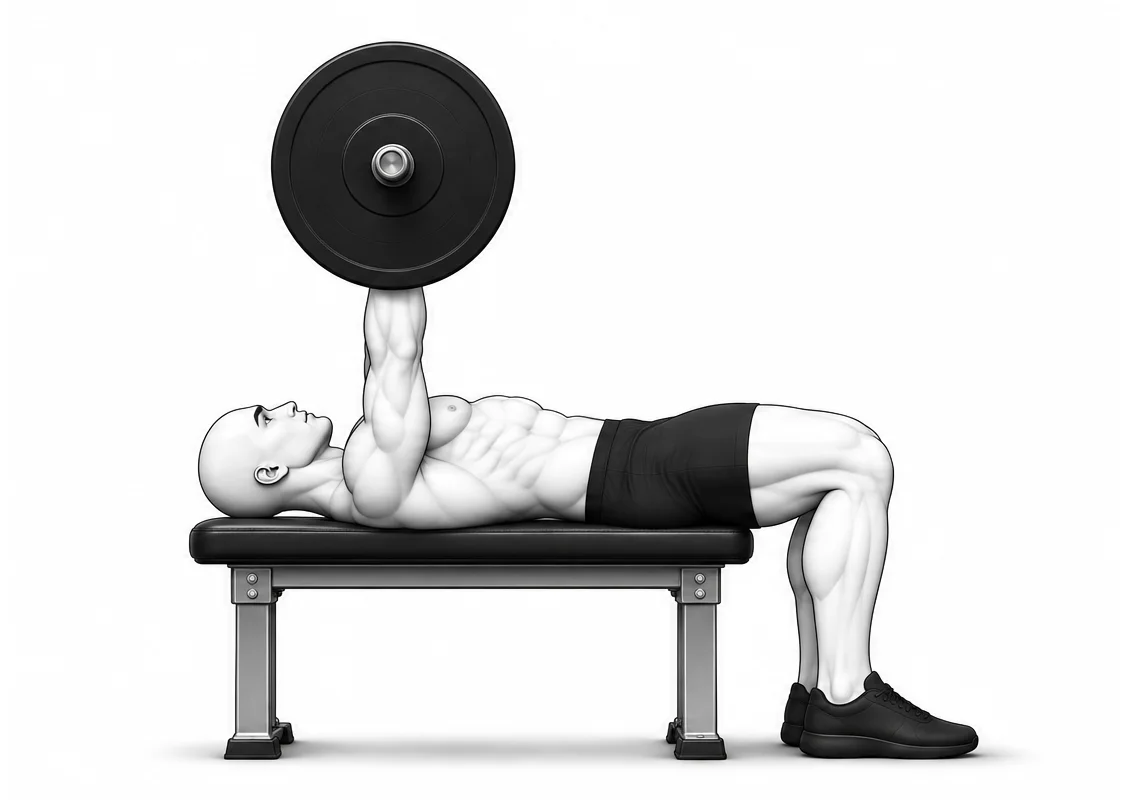
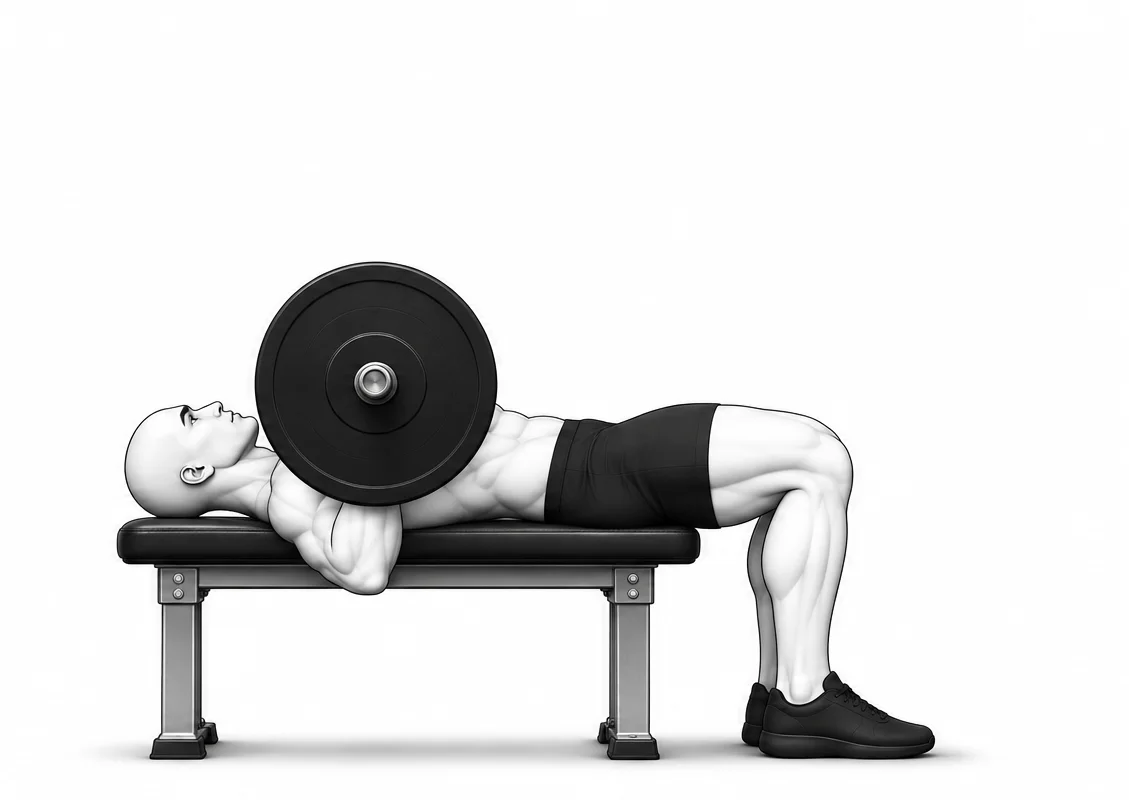
Muscles worked
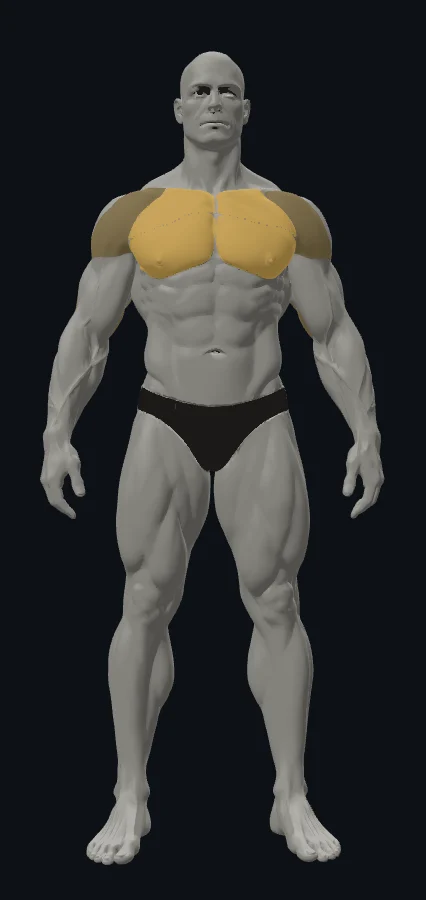
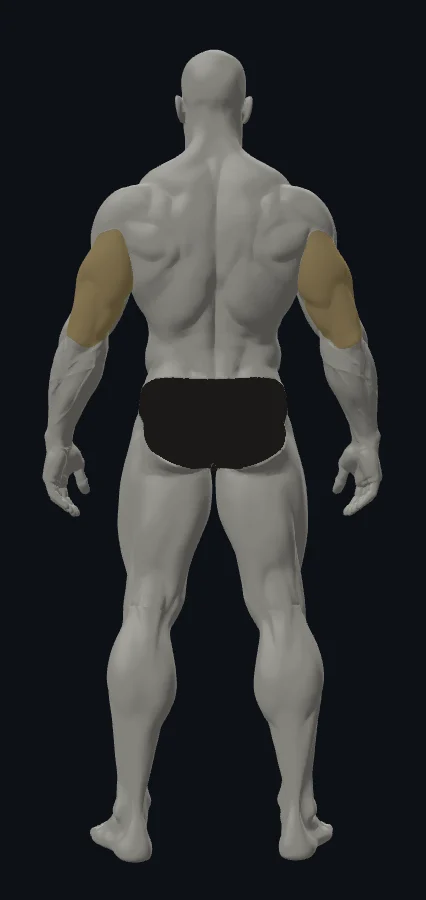
- PRIMARY
- Chest (pectoralis major), front deltoids, triceps
- ASSISTING
- Lats and upper back (to stabilise), biceps, forearms
The bench press works the chest, front shoulders and triceps together. How hard each works depends partly on grip width.
- Chest (pectoralis major) brings the upper arms across the body; it does most of the work off the chest.
- Front deltoids help the chest raise the arms forward.
- Triceps straighten the elbows to lock the bar out. A wide grip used them less than medium and narrow grips [1].
- Biceps work harder as the grip gets wider [1], and when the load is less stable: more with dumbbells than a barbell, and more with a barbell than a Smith machine [2].
- Lats and upper back hold the shoulder blades in place so you press from a stable base.
Setup
- Eyes under the bar. Lie down with your eyes directly below the bar.
- Feet flat. Plant your feet on the floor, roughly under your knees, and keep them there.
- Shoulder blades back and down. Squeeze them together and tuck them down, so your upper chest lifts slightly. Keep your glutes on the bench.
- Grip. Hands just wider than your shoulders, so your forearms are vertical when the bar touches your chest. Wrap your thumbs around the bar and keep your wrists straight.
- Unrack. Press the bar off the hooks and move it until it sits over your shoulders, arms straight.
How to do it
- Breathe and brace. Take a breath and hold it while you lower the bar.
- Lower to the lower chest. Bring the bar down under control to around your nipple line. Your elbows sit about 45° from your sides, not flared straight out.
- Touch, don't bounce. Let the bar lightly touch your chest with your shoulder blades still pinned.
- Press up and back. Drive the bar up and slightly back, so it finishes over your shoulders, not over your face.
- Lock out. Straighten your arms fully, breathe, and start the next rep.
from straight arms to the bar lightly touching your chest.
about 2 seconds down, a brief touch, then press up hard.
Common mistakes
Bouncing the bar off your chest
Momentum does the work at the bottom, and you lose control of where the bar lands
Lower slowly enough to stop the bar for an instant on your chest.
Elbows flared straight out to the sides
Puts the shoulder in a weak, stressed position at the bottom
Tuck your elbows to about 45° from your sides.
Glutes lifting off the bench
Shortens the press and strains the lower back
Keep your glutes down and push through your feet instead.
Bar lowered too high, towards the neck
The forearms tip and the shoulders take more load
Aim for the lower chest, with forearms vertical.
Make it easier or harder
The machine guides the path, so you can focus on pushing and set the weight down at any point.
Hold the bar still on your chest for 1–2 seconds before pressing. It removes the bounce and builds strength from the bottom.
Variations and alternatives
More triceps than a wide grip [1]
Same muscles, hardest off the chest
You want to build strength off the chest and stop bouncing.
Same chest and shoulders; biceps work more to steady it [2]
You want each arm to work on its own. Chest and front-deltoid activity were similar with dumbbells and a barbell, though people lifted 14–17% less weight [2].
More upper chest and front shoulders
You want more emphasis on the upper chest and shoulders.
Chest, shoulders and triceps, with no balancing
You're training without a spotter or want the most stable option.
Where to fit it into your workout
First on a chest or upper-body day. It's the heaviest pressing lift in most programmes, so do it before flyes, raises or triceps work. Strength improves most in lifts done early in a session [5].
Sets and reps: 3–4 working sets of 6–10 reps for muscle and strength, or 3–5 reps if strength is the main goal.
Rest: about 2–3 minutes between sets. Longer rest (three minutes rather than one) produced more strength and muscle in trained lifters [3].
How often: two or three times a week. Training a muscle at least twice a week grew it more than once a week [4].
What to pair it with: a pulling exercise, such as a row or pulldown, to balance the work on the front and back of your shoulders.
Safety
- Set the safety arms just below your chest, or bench with a spotter. Never bench heavy alone without one of them.
- Wrap your thumbs around the bar. A thumbless grip can let the bar roll out of your hands.
- Check with a doctor or physical therapist first if you have an injury, pain or a medical condition, or are pregnant.
- Stop the set if you feel sharp pain, joint pain, dizziness or chest pain. Muscle burn and effort are normal; pain is not.
- This page is general information about exercise technique. It isn't medical advice and doesn't replace advice from a professional who knows your health. See our Terms of Service.
Questions people ask
How do you set up for the bench press?
Lie with your eyes under the bar and plant your feet flat. Squeeze your shoulder blades back and down, then grip so your forearms will be vertical at the bottom. Unrack the bar to a position over your shoulders.
What equipment do you need for the bench press?
A barbell, plates, a flat bench with uprights to hold the bar, and either safety arms or a spotter. With dumbbells and a flat bench you can do the dumbbell version instead.
What muscles does the bench press work?
Mainly the chest, front shoulders and triceps, with the upper back and lats holding you steady. A wider grip uses the triceps less [1].
Should I bench two or three times a week?
At least twice. Training a muscle twice a week or more grew it more than once a week [4]. The evidence doesn't show that three times beats two, so choose whatever lets you recover between sessions.
Sources
- 1Saeterbakken AH, Stien N, Pedersen H, Solstad TEJ, Cumming KT, Andersen V. The effect of grip width on muscle strength and electromyographic activity in bench press among novice- and resistance-trained men. Int J Environ Res Public Health. 2021;18(12):6444.
- 2Saeterbakken AH, van den Tillaar R, Fimland MS. A comparison of muscle activity and 1-RM strength of three chest-press exercises with different stability requirements. J Sports Sci. 2011;29:533–8.
- 3Schoenfeld BJ, et al. Longer interset rest periods enhance muscle strength and hypertrophy in resistance-trained men. J Strength Cond Res. 2016;30(7):1805–12.
- 4Schoenfeld BJ, Ogborn D, Krieger JW. Effects of resistance training frequency on measures of muscle hypertrophy. Sports Med. 2016;46(11):1689–97.
- 5Nunes JP, et al. What influence does resistance exercise order have on muscular strength gains and muscle hypertrophy? Eur J Sport Sci. 2021;21(2):149–57.