Hyperextensions (Back Extensions)
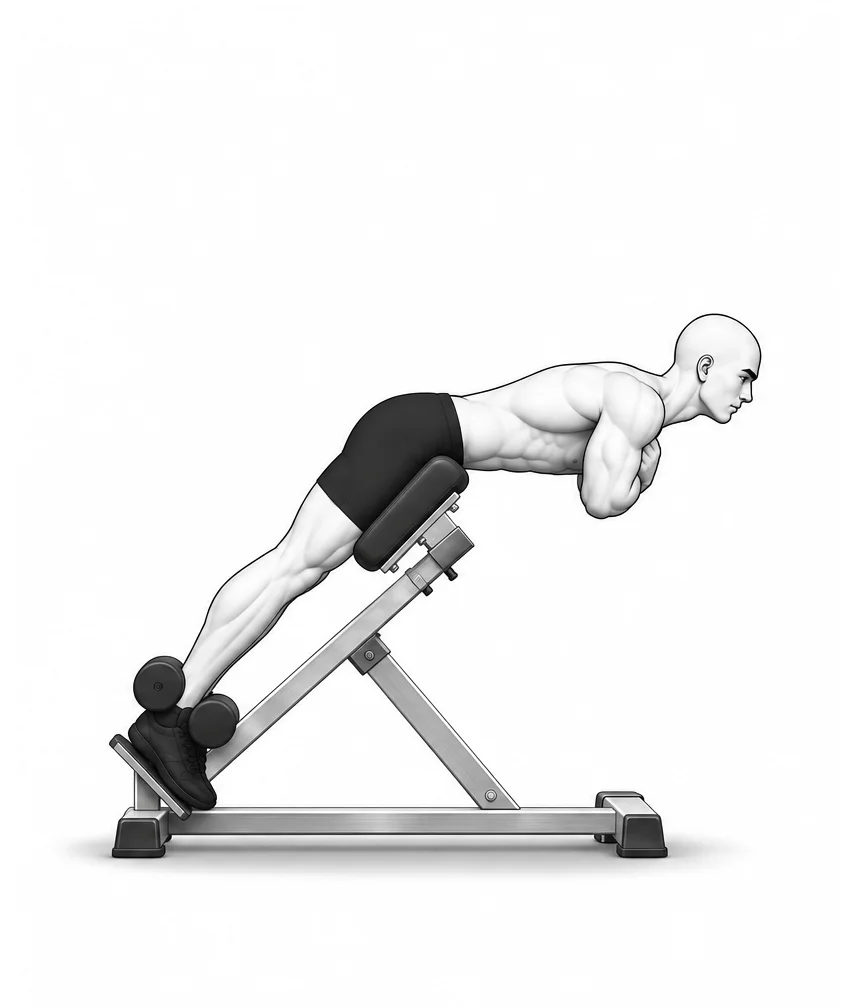
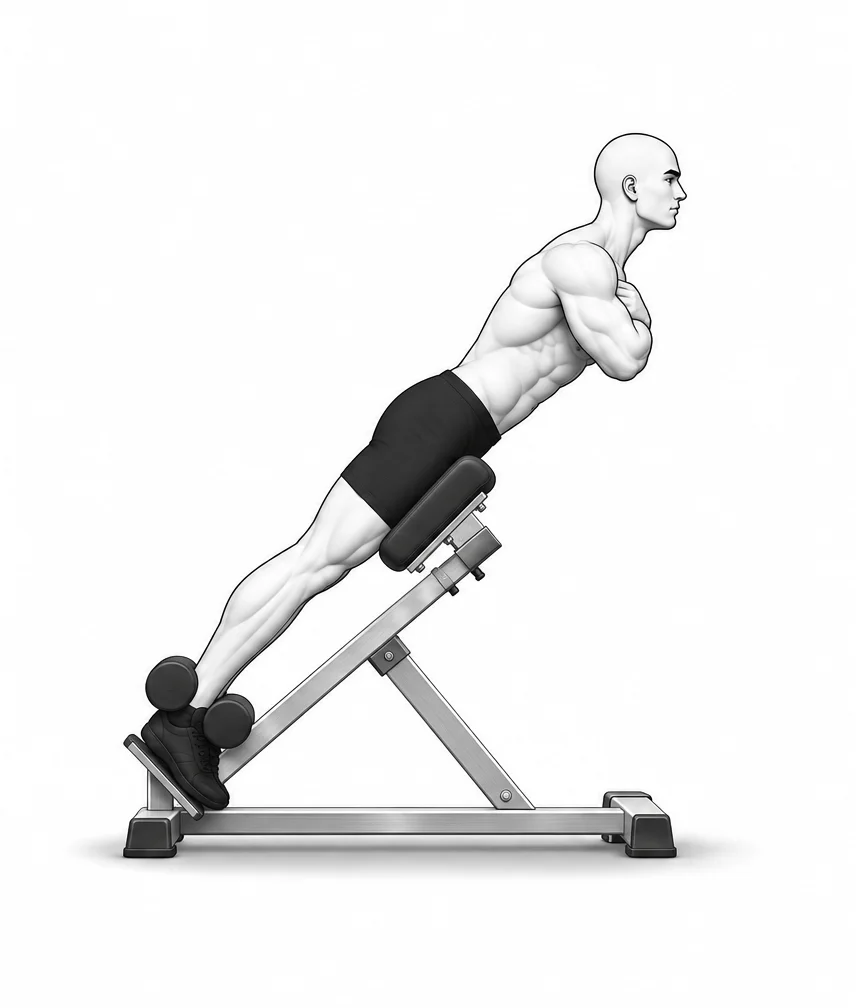
The hyperextension is a hip hinge on a padded bench. With your feet locked in and the pad at your hips, you lower your upper body towards the floor, then raise it until your body is in a straight line. It trains the lower back, glutes and hamstrings with your bodyweight.
- TYPE
- Isolation: only the hips move; the spine is held still
- PRIMARY MUSCLES
- Lower back (spinal erectors), glutes
- ALSO WORKING
- Hamstrings
- EQUIPMENT
- 45-degree back extension bench
- DIFFICULTY
- Beginner
Form images
Muscles worked
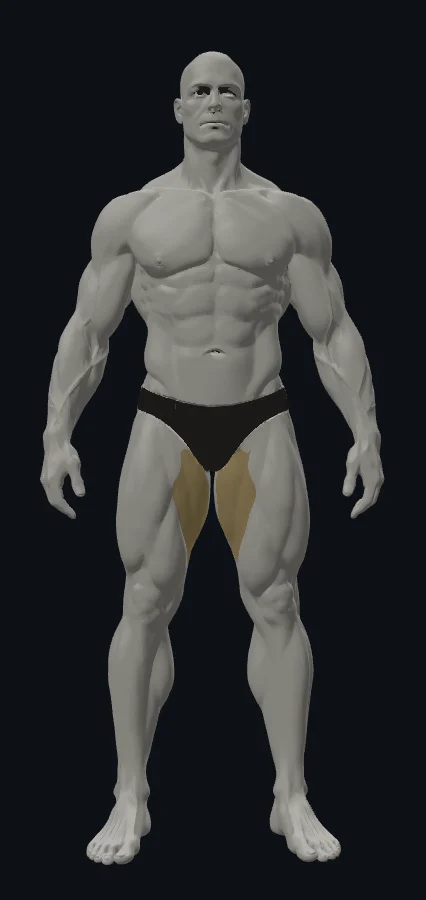
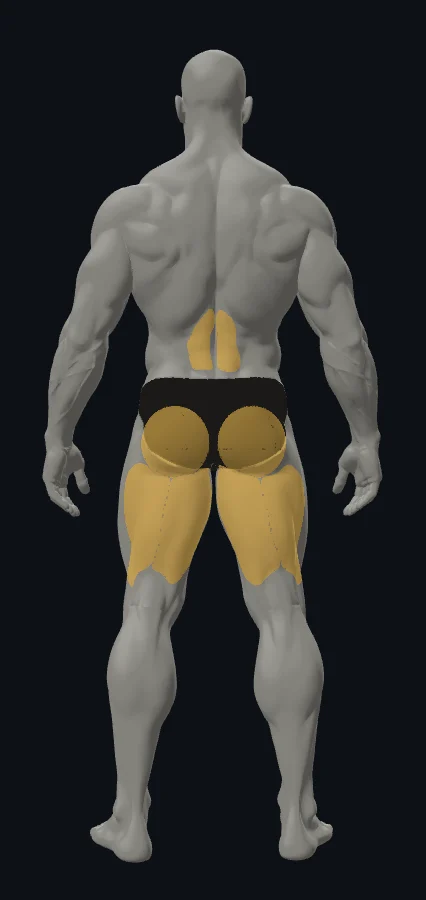
- PRIMARY
- Lower back (spinal erectors), glutes
- ASSISTING
- Hamstrings
The hyperextension works the lower back and glutes together, with the hamstrings helping.
- Lower back (spinal erectors) hold your spine straight while it moves as one piece. On a back extension bench, their share of the effort was about the same as in a floor bridge and a held back extension [1].
- Glutes and hamstrings straighten your hips to lift your upper body.
Setup
- Set the hip pad so its top edge sits just below your hip bones, not on your stomach. You should be able to fold forward freely.
- Lock your heels under the foot pads.
- Cross your arms on your chest.
- Start in a straight line, then brace your trunk.
How to do it
- Hinge forward at the hips, keeping your back flat.
- Lower until you feel a stretch in your hamstrings, or just before your back starts to round.
- Squeeze your glutes to lift your upper body.
- Stop in a straight line from head to heels.
- Lower under control into the next rep.
from folded forward with a flat back to your body in a straight line.
about 2 seconds down, a steady lift, a 1-second pause at the top.
Common mistakes
Arching past straight at the top
It compresses the lower back without working anything more
Stop when your body is in a straight line.
Pad too high on the stomach
You can't hinge at the hips, so your back bends instead
Lower the pad until it sits below your hip bones.
Swinging up
Momentum does the work
Lift smoothly and pause at the top.
Rounding to reach lower
Your spine takes the strain your hips should
Stop the descent while your back is still flat.
Make it easier or harder
Variations and alternatives
Same muscles, with more load
Bodyweight reps are easy for 15 or more.
Glutes more, lower back less
You want the movement to aim at the glutes.
Hamstrings and glutes, standing
You don't have the bench.
Glutes, with no lower back load
You want glute work without loading your back.
Where to fit it into your workout
Near the end of a leg or back session, after your heavy lifts.
Sets and reps: 2–3 sets of 10–15 reps.
Rest: 60–90 seconds.
How often: once or twice a week.
What to pair it with: a core exercise such as the plank or dead bug.
Safety
- Stop at a straight line. Don't arch past it at the top.
- Move slowly, with no swinging, especially on the way up.
- Check with a doctor or physical therapist first if you have an injury, pain or a medical condition, or are pregnant.
- Stop the set if you feel sharp pain, joint pain, dizziness or chest pain. Muscle burn and effort are normal; pain is not.
- This page is general information about exercise technique. It isn't medical advice and doesn't replace advice from a professional who knows your health. See our Terms of Service.
Questions people ask
Is the hyperextension bad for the back?
Not when done as described here: a flat back, a controlled pace, and stopping at a straight line. Arching hard past straight and swinging are what to avoid.
Is the hyperextension for the back or the glutes?
Both. The flat-back version shares the work between the lower back and glutes. Rounding your upper back slightly and squeezing your glutes shifts more of it to the glutes.
Can the hyperextension fix lower back pain?
We can't tell you that. If you have back pain, check with a doctor or physical therapist before you start.
What's better, RDLs or hyperextensions?
They do different jobs. A Romanian deadlift loads the hamstrings and glutes much more heavily; the hyperextension is lighter and easier to learn. Many programmes use both.
Sources
- 1Yoo WG. Comparison of the isolated contraction ratios of the hip extensors and erector spinae muscles of the lumbar region and thoracic muscles during different back extension exercises. J Phys Ther Sci. 2015;27(2):315–6.