Cable Curl
The cable curl is a biceps curl against a cable instead of a free weight. Standing in front of a low pulley with a bar in your hands, you bend your elbows to bring the bar up to your shoulders, then lower it until your arms are straight. The cable keeps pulling all the way down, so the bottom of the rep still has load on it.
- TYPE
- Isolation: works the elbow only
- PRIMARY MUSCLES
- Biceps
- ALSO WORKING
- Brachialis, brachioradialis (forearm)
- EQUIPMENT
- Cable station with a low pulley and a straight bar
- DIFFICULTY
- Beginner
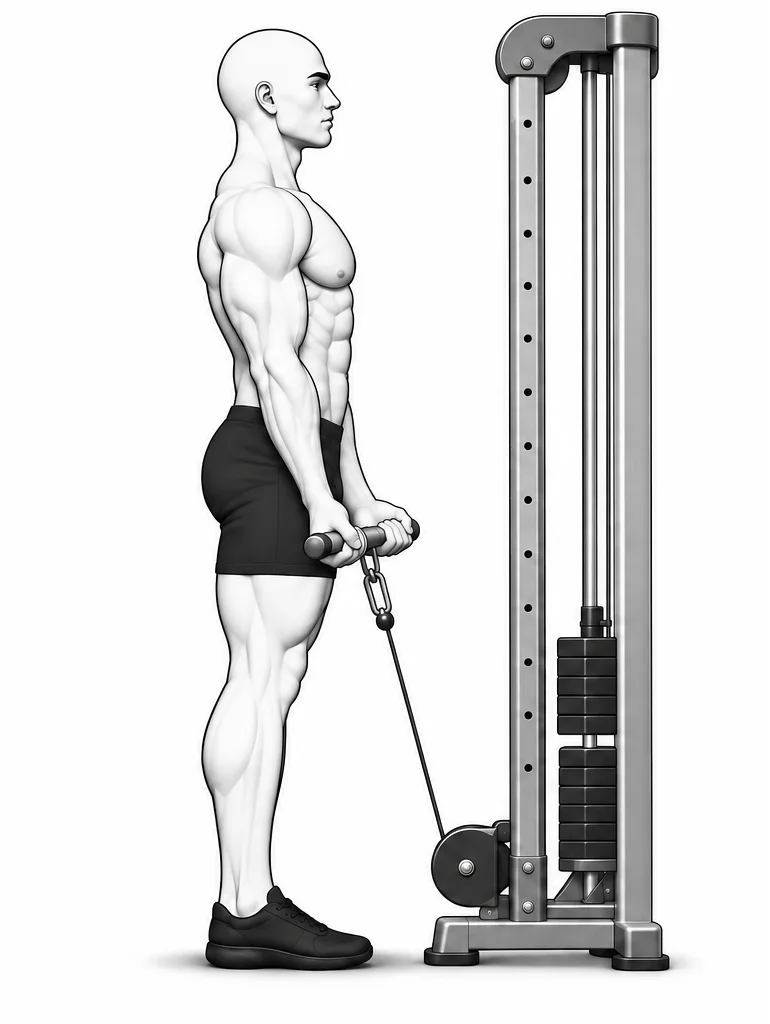
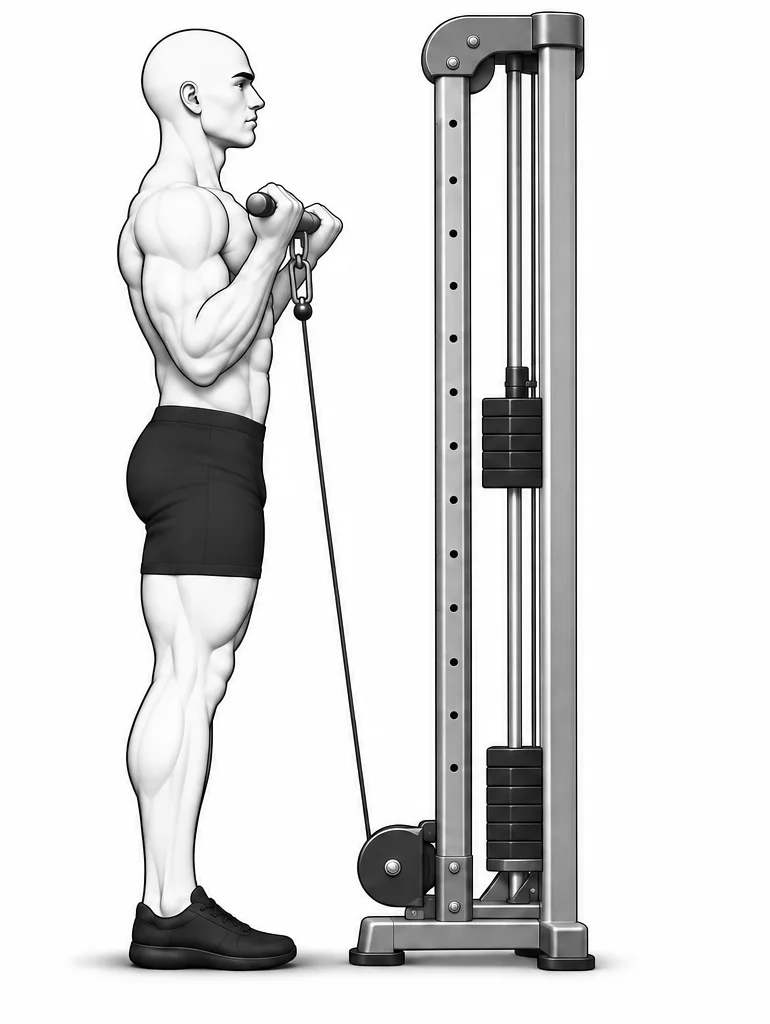
Form images
Muscles worked
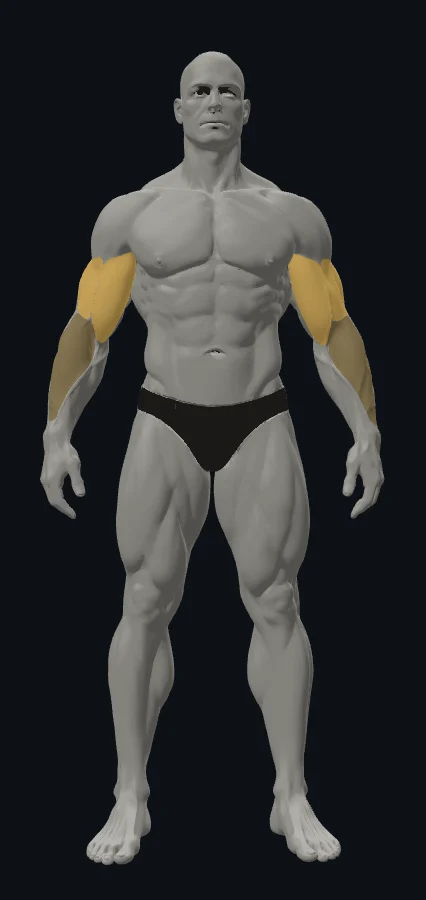
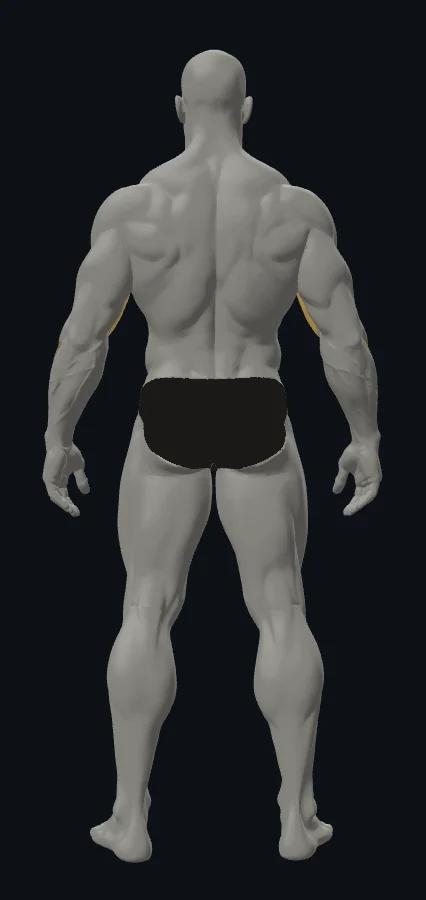
- PRIMARY
- Biceps
- ASSISTING
- Brachialis, brachioradialis (forearm)
The cable curl is a biceps lift, with two elbow muscles under it.
- Biceps bend the elbow and turn the palm up. An underhand grip keeps them doing most of the work.
- Brachialis sits under the biceps and bends the elbow whatever your grip.
- Brachioradialis in the forearm helps, more so with a neutral or overhand grip.
- The bottom of the curl: training the half of the curl nearest a straight arm built more elbow-flexor muscle than training the half nearest a bent arm [1]. The cable keeps that bottom half loaded.
Setup
- Set the pulley to its lowest position and attach a straight bar.
- Take the bar underhand, hands about shoulder-width apart.
- Stand up tall and step back slightly, so the cable runs a little forward of your body.
- Pin your elbows to your sides with your arms straight.
How to do it
- Curl the bar up by bending only at the elbows.
- Keep your elbows by your sides; they shouldn't drift forward.
- Finish with the bar near your shoulders and squeeze for a moment.
- Lower slowly until your arms are completely straight.
- Start the next rep from a straight arm, without letting the weight stack touch down.
from straight arms to the bar near your shoulders.
about 1 second up, 2–3 seconds down.
Common mistakes
Leaning back to finish
Your hips and back lift the bar, not your biceps
Stand tall and lower the weight until your torso stays still.
Elbows sliding forward
The front of the shoulder joins in and the biceps do less
Keep your elbows at your sides from the first rep to the last.
Stopping before a straight arm
It skips the stretched half, which built more muscle in a curl study [1]
Lower all the way until your elbows are straight.
Bending the wrists to curl the last inch
The forearm flexors take over and the wrists get strained
Keep your wrists straight and stop where your elbows stop.
Make it easier or harder
Your free hand can hold the machine for balance.
Variations and alternatives
More brachialis and forearm, with a neutral grip
Underhand grips bother your wrists, or you want thicker forearms.
Same muscles, one side at a time
You want to even out your arms or focus on one side.
Biceps, with free weights
You don't have a cable station, or you want to turn your palms up as you curl.
Back, with the biceps helping
You want a back lift that also trains your arms.
Where to fit it into your workout
Place: after your back work, when your biceps have already helped with the pulls.
Sets and reps: 2 or 3 sets of 10–15. Taking sets near failure mattered more than the weight on the stack [2].
Rest: 60–90 seconds.
How often: two or more arm sessions a week grew muscle better than one [3].
What to pair it with: the triceps pushdown, alternating sets at the same station.
Safety
- Stand far enough from the stack that the plates never touch down mid-set.
- Use a load you can control on the way down; don't let the cable yank your arms straight.
- Check with a doctor or physical therapist first if you have an injury, pain or a medical condition, or are pregnant.
- Stop the set if you feel sharp pain, joint pain, dizziness or chest pain. Muscle burn and effort are normal; pain is not.
- This page is general information about exercise technique. It isn't medical advice and doesn't replace advice from a professional who knows your health. See our Terms of Service.
Questions people ask
Which part of the biceps does the cable curl work?
Both heads of the biceps. Your grip and arm position shift the emphasis a little, but a regular underhand curl trains the whole muscle.
Should I do it with one arm or two?
Either. Two arms with a bar is quicker; one arm with a handle lets you focus on each side and fix a difference between them.
What is the face-away cable curl?
You stand facing away from a low pulley, with your arm behind your body, and curl forward. Your arm starts behind you, so the biceps begin the curl more stretched.
What is the overhead cable curl?
You stand between two high pulleys, arms out to the sides, and curl the handles towards your head. It trains the biceps with your arms raised.
Sources
- 1Sato S, Yoshida R, Kiyono R, Yahata K, Yasaka K, Nunes JP, Nosaka K, Nakamura M. Elbow joint angles in elbow flexor unilateral resistance exercise training determine its effects on muscle strength and thickness of trained and non-trained arms. Front Physiol. 2021;12:734509.
- 2Schoenfeld BJ, Grgic J, Ogborn D, Krieger JW. Strength and hypertrophy adaptations between low- vs. high-load resistance training: a systematic review and meta-analysis. J Strength Cond Res. 2017;31(12):3508–23.
- 3Schoenfeld BJ, Ogborn D, Krieger JW. Effects of resistance training frequency on measures of muscle hypertrophy. Sports Med. 2016;46(11):1689–97.