Pushup
The push-up is a press you do with your bodyweight. In a straight plank on your hands and toes, you lower your chest to the floor and push it back up. It needs no equipment, and it trains your trunk as well as your chest.
- TYPE
- Compound: works shoulders and elbows together
- PRIMARY MUSCLES
- Chest
- ALSO WORKING
- Front delts, triceps, abdominals
- EQUIPMENT
- None
- DIFFICULTY
- Beginner
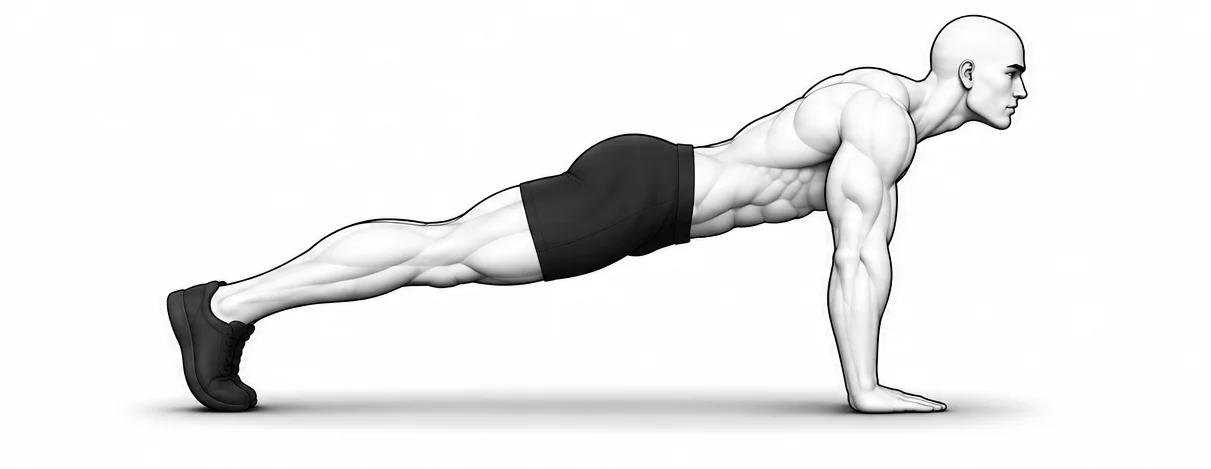
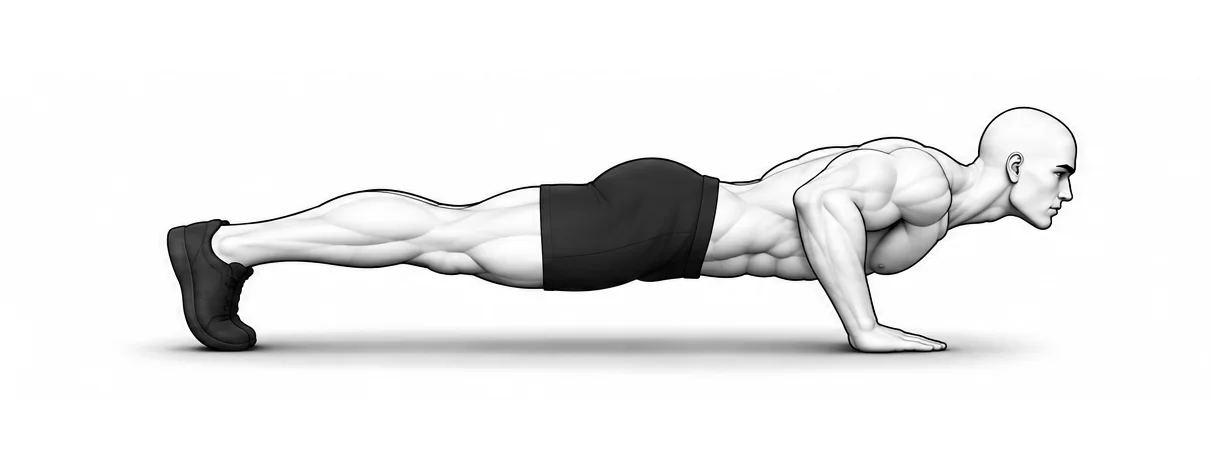
Form images
Muscles worked
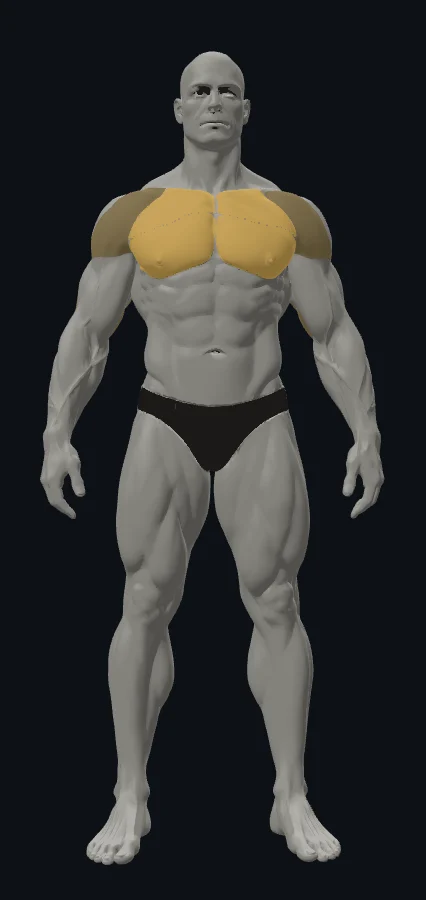
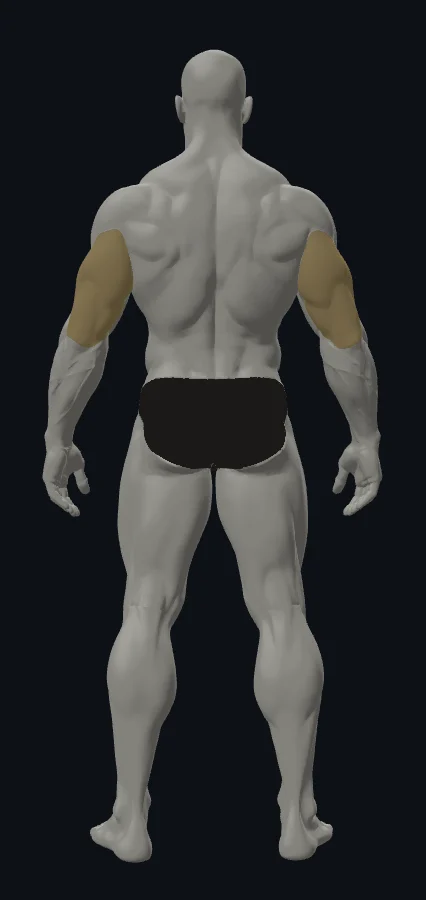
- PRIMARY
- Chest
- ASSISTING
- Front delts, triceps, abdominals
The push-up works the same pressing muscles as the bench press, and your abs work to hold your body straight.
- Chest and triceps do most of the work. In young men, eight weeks of push-ups grew the chest and triceps as much as bench pressing a similar load [1].
- Front delts help at the shoulder.
- Abdominals stop your hips sagging.
Setup
- Hands on the floor just wider than your shoulders, fingers pointing forward.
- Step your feet back so you're in a straight plank on your toes.
- Shoulders over your wrists.
- Squeeze your glutes and brace your abs.
How to do it
- Lower your chest towards the floor, elbows angled about 45 degrees from your body.
- Keep one straight line from head to heels.
- Go down until your chest nearly touches the floor.
- Push the floor away to straighten your arms.
- Keep your hips in line on the way up.
from arms straight to chest just above the floor.
about 2 seconds down, a steady push up.
Common mistakes
Hips sagging
Your lower back arches and the rep gets easier
Squeeze your glutes and brace your abs.
Half reps
The chest gets far less stretch
Lower until your chest nearly touches the floor.
Elbows flared to the sides
It loads the front of the shoulder
Angle your elbows back to about 45 degrees.
Head dropping first
Your neck moves instead of your chest
Look at the floor just ahead of your hands.
Make it easier or harder
The higher your hands, the easier it gets.
Variations and alternatives
Same muscles, less load
You can't do 8 full push-ups yet.
Same muscles, less load
A bench or box isn't handy.
Chest, with load you can add
Push-ups are easy for 20 or more.
Chest, with no trunk demand
You want to load the chest without holding a plank.
Where to fit it into your workout
On push day, or anywhere you have no equipment.
Sets and reps: 3 sets, each close to failure. Light loads built muscle as well as heavy ones when sets ended close to failure [2], so high-rep push-ups still count.
Rest: about 90 seconds.
How often: train your chest at least twice a week [3].
What to pair it with: a row or pull-up.
Safety
- Keep your wrists under your shoulders; if they hurt, hold dumbbell handles or use push-up handles to keep them straight.
- Check with a doctor or physical therapist first if you have an injury, pain or a medical condition, or are pregnant.
- Stop the set if you feel sharp pain, joint pain, dizziness or chest pain. Muscle burn and effort are normal; pain is not.
- This page is general information about exercise technique. It isn't medical advice and doesn't replace advice from a professional who knows your health. See our Terms of Service.
Questions people ask
How do I do a push-up if I can't do one yet?
Start with your hands on a bench or box. As you get stronger, lower the surface until you reach the floor.
Is the push-up good for beginners?
Yes, and it builds muscle: in one study, push-ups grew the chest as much as a bench press with a similar load [1].
Is correct push-up form different for women?
No. The same straight-line position applies to everyone; use an incline to make it easier.
Are knee push-ups worth doing?
Yes, as a step towards full push-ups. Keep a straight line from head to knees.
Sources
- 1Kikuchi N, Nakazato K. Low-load bench press and push-up induce similar muscle hypertrophy and strength gain. J Exerc Sci Fit. 2017;15(1):37–42.
- 2Schoenfeld BJ, Grgic J, Ogborn D, Krieger JW. Strength and hypertrophy adaptations between low- vs. high-load resistance training: a systematic review and meta-analysis. J Strength Cond Res. 2017;31(12):3508–23.
- 3Schoenfeld BJ, Ogborn D, Krieger JW. Effects of resistance training frequency on measures of muscle hypertrophy. Sports Med. 2016;46(11):1689–97.