Overhead Press
The overhead press, also called the standing military press, is a barbell press from your shoulders to straight arms overhead, standing up. Your legs stay locked, so your shoulders and triceps do the pressing while your whole body holds still.
- TYPE
- Compound: works shoulders and elbows together
- PRIMARY MUSCLES
- Front delts, triceps
- ALSO WORKING
- Side delts, upper chest, upper back, abs and glutes (to brace)
- EQUIPMENT
- Barbell and a rack set at shoulder height
- DIFFICULTY
- Intermediate: learn to brace first
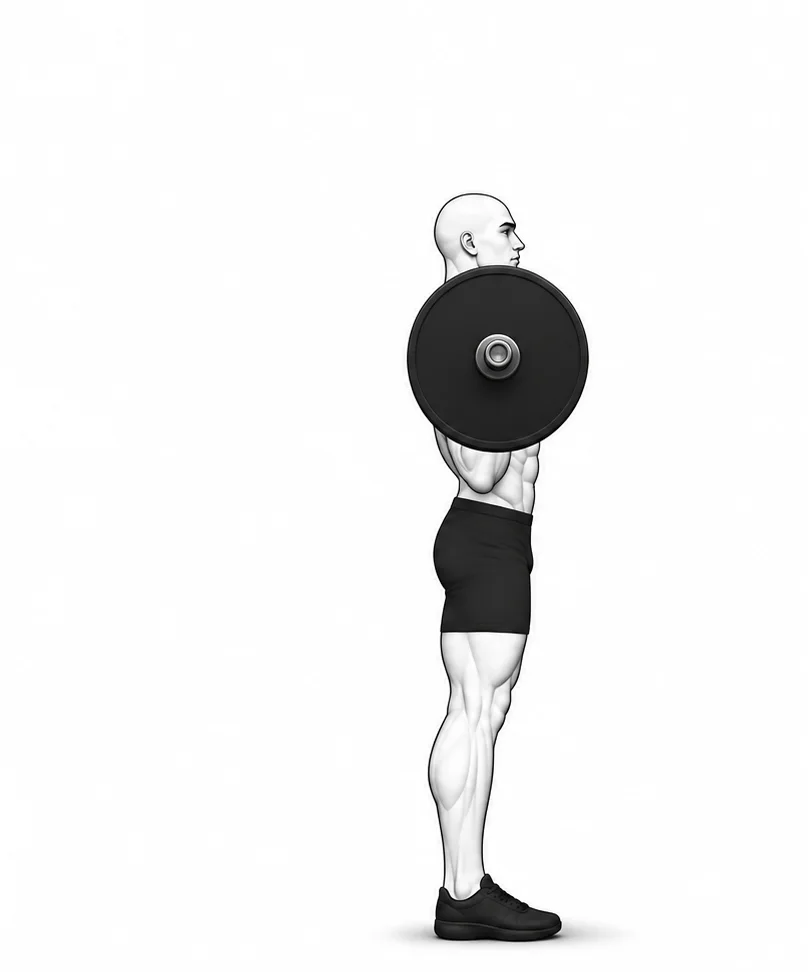
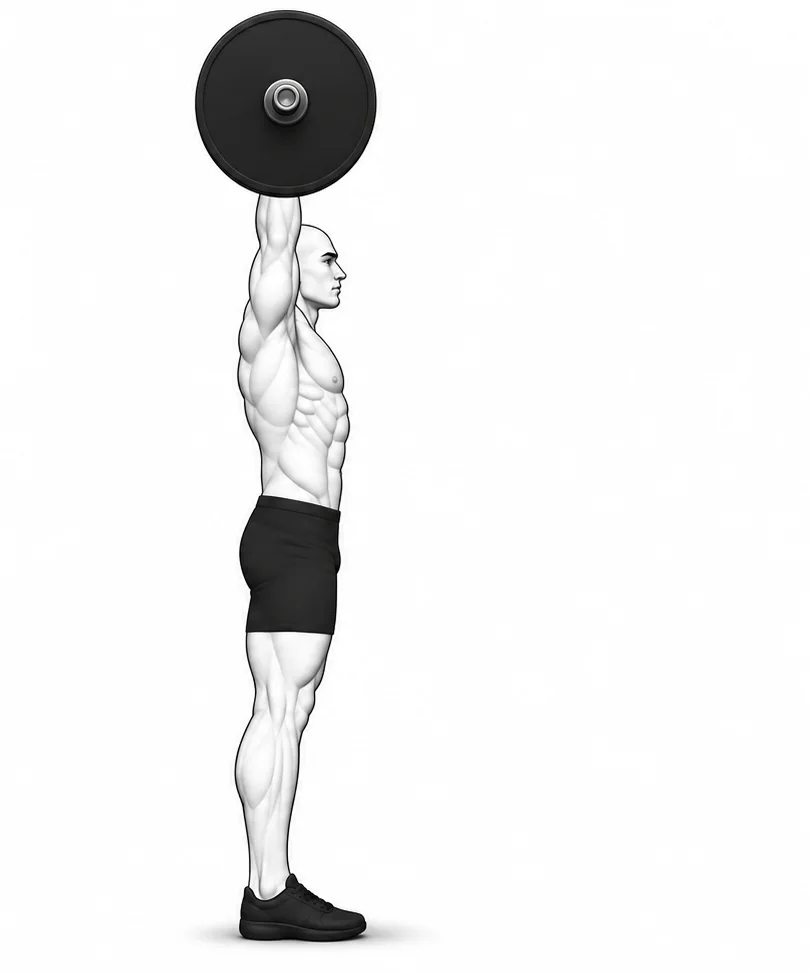
Form images
Muscles worked
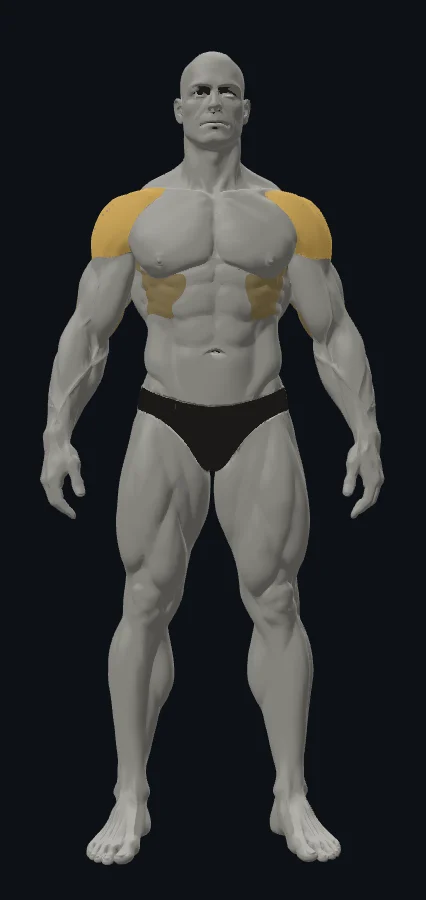
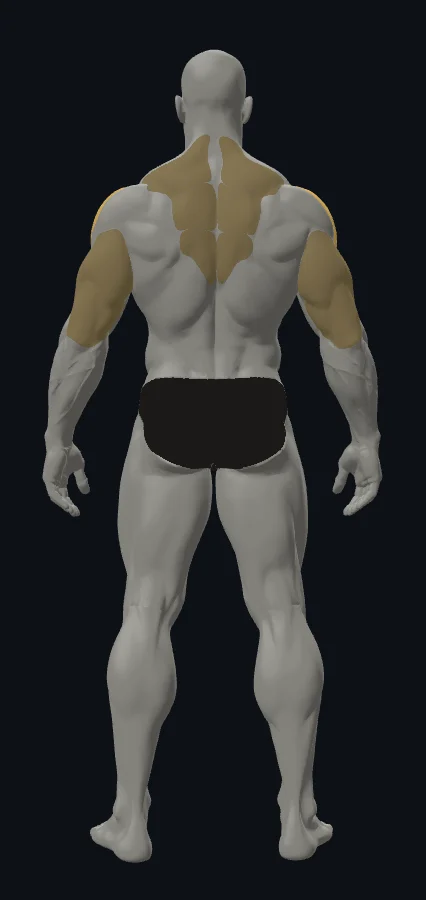
- PRIMARY
- Front delts, triceps
- ASSISTING
- Side delts, upper chest, upper back, abs and glutes (to brace)
The press works the front of the shoulders and the triceps, with the rest of the body holding you steady.
- Front delts raise the arms overhead and do most of the shoulder work.
- Triceps straighten the elbows. In 15 trained men, the standing barbell press worked the triceps about 39% harder than standing dumbbell presses [1].
- Side delts help, more so with dumbbells than a barbell [1].
- Abs, glutes and back hold your torso still. In the same study, the press that was hardest to balance (standing, with dumbbells) produced the most shoulder activity but the lowest maximum [1].
Setup
- Set the bar in a rack at about collarbone height.
- Grip just outside your shoulders, thumbs around the bar, the bar low in your palm over your forearm bones.
- Step under it so the bar rests on the front of your shoulders, elbows under or just in front of the bar.
- Lift it out and take one or two steps back. Feet hip-width apart, flat on the floor.
- Squeeze your glutes and brace your abs so your body is one rigid column.
How to do it
- Tip your chin back just enough for the bar to pass your face.
- Press straight up. The bar travels close to your face, not out in front of it.
- Bring your head through between your arms once the bar passes your forehead.
- Lock your elbows with the bar over your mid-foot and your shoulders.
- Lower it the same way to the front of your shoulders, pulling your chin back as it passes.
from the bar on the front of your shoulders to straight arms overhead.
a strong press, about 2 seconds down.
Common mistakes
Leaning back into a big arch to finish the rep
It turns the press into a steep incline press and loads your lower back
Squeeze your glutes harder and use a weight you can press with your body upright.
Bar drifting forward around your face
It ends up in front of you and is far harder to hold
Keep the bar close and bring your head through as it passes.
Bending the knees to drive the bar up
That's a push press: the legs do the hard part
Lock your knees and keep them locked.
Elbows behind the bar at the start
The bar sits ahead of your forearms and drifts forward from the first inch
Set the elbows under the bar, or a touch in front, before each rep.
Make it easier or harder
Variations and alternatives
Shoulders, with less bracing
You want to press heavier without the balance demand.
The same muscles, with legs helping
You want to handle more weight, or train power.
Front and side delts, each arm on its own [1]
You want a freer arm path, or one side is weaker.
Front delts, on a fixed path
You're learning, or want to press to failure safely.
Upper chest, with the front delts
You want a press that also trains the chest.
Where to fit it into your workout
Place: early on a shoulder or upper-body day. Pressing overhead after heavy bench work leaves less in the tank for both.
Sets and reps: 3–4 sets of 5–10. Sets of 5 build strength in the lift; whether you use low or high reps matters less for muscle, as long as each set ends near failure [2].
Rest: long enough to press the next set with the same form, usually 2–3 minutes.
How often: two shoulder sessions a week or more [3]; the press can be one, and a lateral raise day the other.
What to pair it with: a vertical pull such as the pulldown, then lateral raises for the side delts.
Safety
- Press in a rack with the safety pins set just below shoulder height, so a missed rep goes onto the pins.
- If a rep stalls, lower the bar back to your shoulders under control, or step back and let it go forward onto the pins. Don't lean back to save it.
- Check with a doctor or physical therapist first if you have an injury, pain or a medical condition, or are pregnant.
- Stop the set if you feel sharp pain, joint pain, dizziness or chest pain. Muscle burn and effort are normal; pain is not.
- This page is general information about exercise technique. It isn't medical advice and doesn't replace advice from a professional who knows your health. See our Terms of Service.
Questions people ask
What is the overhead press?
A standing barbell press from your shoulders to straight arms overhead. "Military press" is another name for the same lift; some coaches use it only when the heels are together.
Why is the overhead press so hard?
You're pressing with smaller muscles than in a bench press, and standing, so your body has to hold still at the same time. In one study, men's best standing dumbbell press was about 10% below their best seated one [1].
What are the best shoulder exercises?
A press for the front delts, a lateral raise for the side delts, and a rear delt fly for the back of the shoulder cover all three heads. Pick versions you can load and progress.
Sources
- 1Saeterbakken AH, Fimland MS. Effects of body position and loading modality on muscle activity and strength in shoulder presses. J Strength Cond Res. 2013;27(7):1824–31.
- 2Schoenfeld BJ, Grgic J, Ogborn D, Krieger JW. Strength and hypertrophy adaptations between low- vs. high-load resistance training: a systematic review and meta-analysis. J Strength Cond Res. 2017;31(12):3508–23.
- 3Schoenfeld BJ, Ogborn D, Krieger JW. Effects of resistance training frequency on measures of muscle hypertrophy. Sports Med. 2016;46(11):1689–97.