Barbell Deadlift
The conventional deadlift lifts a loaded barbell from the floor to standing: you push the floor away with your legs, then drive your hips forward, with the bar travelling up against your legs the whole way.
- TYPE
- Compound: works hips, knees and back together
- PRIMARY MUSCLES
- Spinal erectors, quadriceps, glutes, hamstrings
- ALSO WORKING
- Lats, upper back, forearms (grip), core
- EQUIPMENT
- Barbell and plates, ideally on a lifting platform
- DIFFICULTY
- Intermediate: learn the hip hinge first, with the trap-bar deadlift or Romanian deadlift
Form images
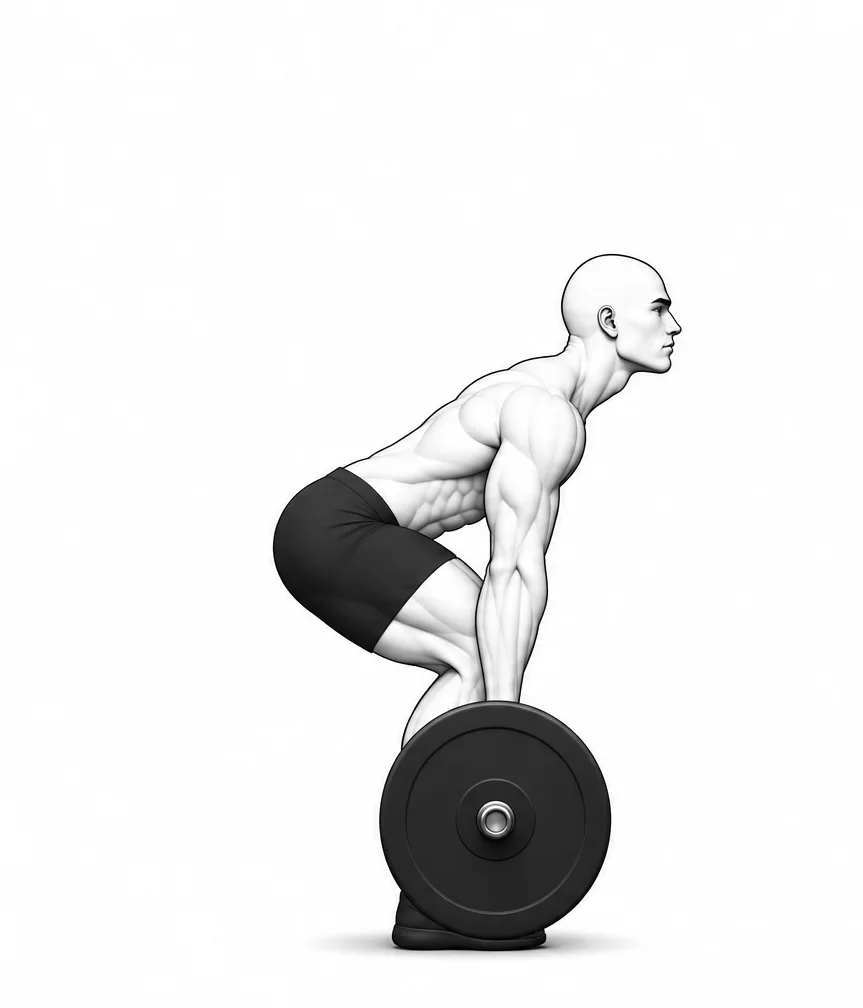
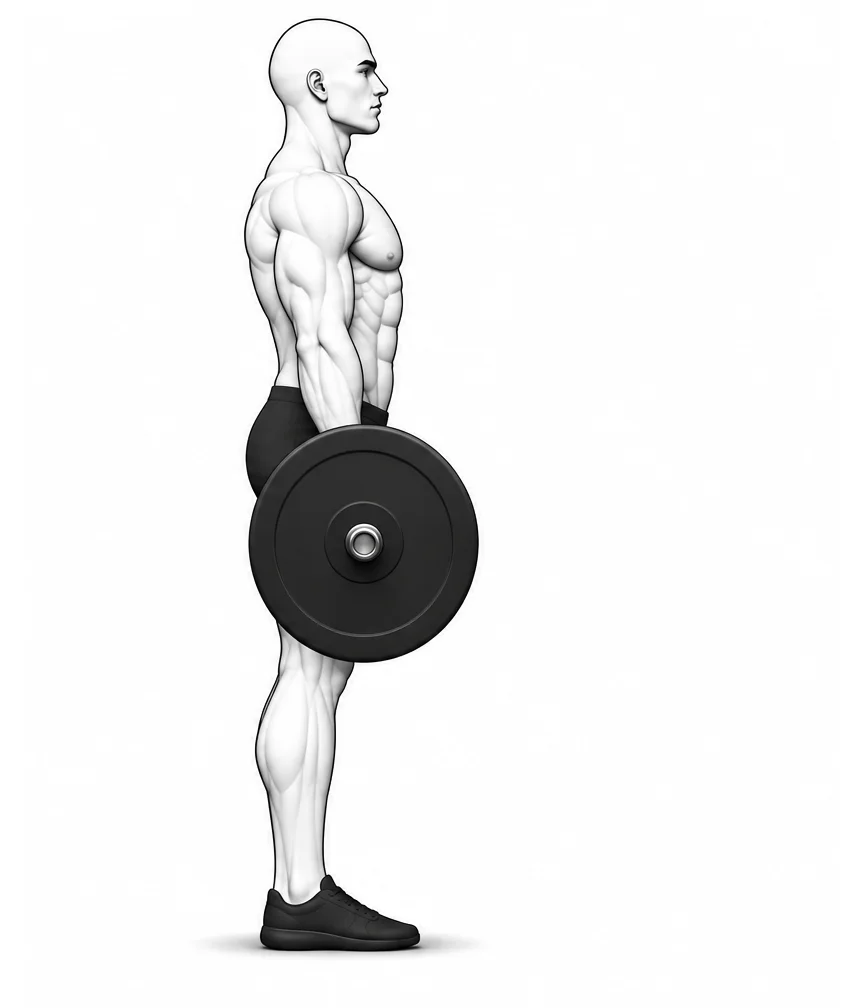
Muscles worked
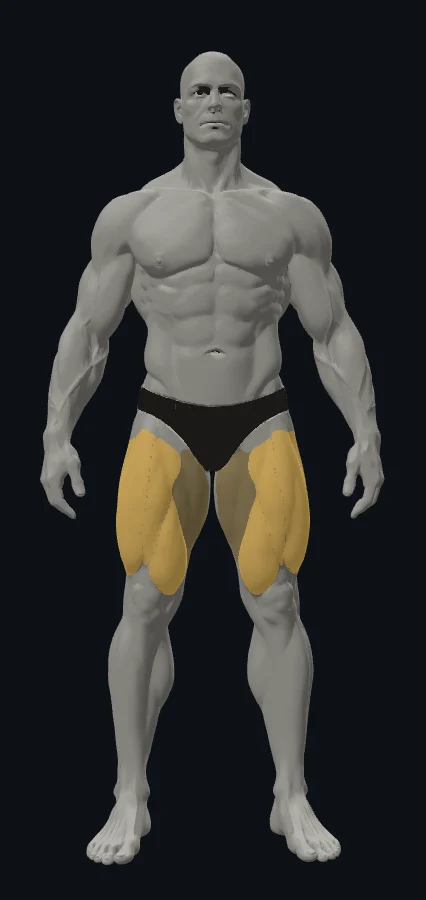
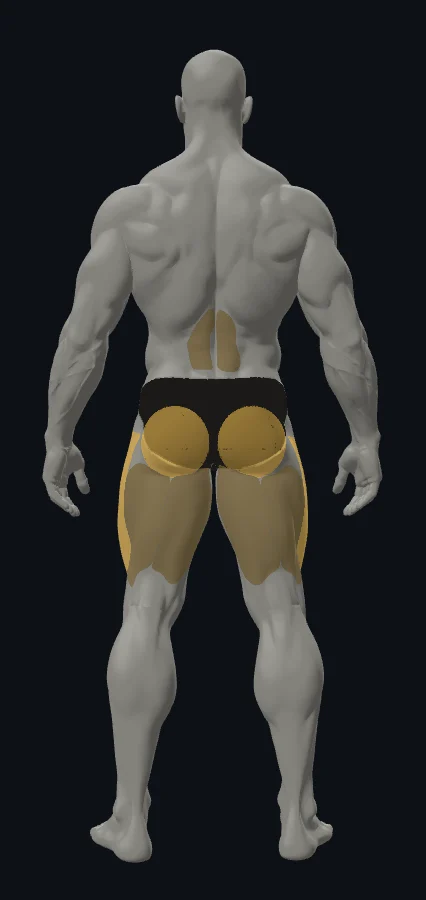
- PRIMARY
- Spinal erectors, quadriceps, glutes, hamstrings
- ASSISTING
- Lats, upper back, forearms (grip), core
The deadlift trains the whole back of the body, but not evenly. Across the studies in a 2020 systematic review, the spinal erectors and quadriceps showed more activity than the glutes and hamstrings [1].
- Spinal erectors hold your back flat while the bar is heaviest, near the floor.
- Quadriceps straighten the knees to break the bar off the floor.
- Glutes finish the lift, driving the hips forward to lockout.
- Hamstrings work with the glutes to extend the hip; they also stop the knees bending as you hinge.
- Lats and upper back keep the bar pinned against your legs and your shoulders from rolling forward.
Setup
- Stance. Feet about hip-width apart, toes turned out slightly. The bar sits over the middle of your foot, about 2–3 cm from your shins.
- Grip. Hinge down and take a double-overhand grip just outside your legs. For heavy sets, a mixed grip or lifting straps stop your grip giving out first.
- Shins to the bar. Bend your knees until your shins touch the bar. Don't roll the bar towards you.
- Back flat. Lift your chest and tighten your lats, as if putting your shoulder blades in your back pockets. Pull up just hard enough to take the slack out of the bar, so it clicks against the plates.
- Brace. Breathe into your belly and tighten your trunk before the bar leaves the floor.
How to do it
- Push the floor away. Drive through your whole foot. Your hips and shoulders rise at the same rate, so your back angle stays the same until the bar passes your knees.
- Keep the bar on your legs. It slides up your shins and thighs in a straight vertical line over mid-foot.
- Drive the hips through. Once the bar passes your knees, push your hips forward to stand up.
- Lock out tall. Finish with hips and knees straight and glutes tight. Stand straight; don't lean back.
- Lower it the same way. Push your hips back first and let the bar slide down your thighs; bend your knees once it passes them. Set it down, reset your brace, then start the next rep.
from the floor to full lockout, every rep.
a strong, steady pull up, and about 2 seconds down under control. Don't bounce the bar off the floor to start the next rep.
Common mistakes
Back rounds as the bar leaves the floor
Your spine takes load your hips and legs should be carrying
Take the slack out of the bar before you pull, tighten your lats, and reduce the weight until your back stays flat.
Hips shoot up first
Your legs straighten before the bar moves, turning the lift into a stiff-legged pull on your lower back
Push the floor away with your legs; hips and shoulders rise together.
Bar drifts away from your legs
The further the bar is from your hips, the harder your back has to work to hold it
Tighten your lats and drag the bar up your legs.
Leaning back at the top
Bends the lower back backwards under load and adds nothing to the lift
Finish by squeezing your glutes and standing straight.
Make it easier or harder
You stand inside the frame, so the load sits in line with your body. Powerlifters lifted more weight with it (265 vs 245 kg one-rep max) with lower peak loads on the lower back and hips, and more work for the knees [3].
Pause for 2 seconds just after the bar leaves the floor or just below the knee. It removes momentum and strengthens the weakest part of your pull.
Variations and alternatives
More quads and inner thighs; torso more upright [2]
A wide stance with your hands inside your knees. Sumo lifters kept their torso 5–10° more upright, while conventional lifters moved the bar 25–40% farther and did more mechanical work [2]. Choose it if a long torso or tight hips make conventional uncomfortable.
Same muscles, hardest off the floor
You want to build strength off the floor and stop rushing the start.
More knees, less lower back and hips [3]
You want a more upright, knee-friendly pull that is easier to learn, or your lower back is the limit [3].
Hamstrings and glutes, through a long stretch
You want to train the hamstrings and glutes through a long stretch, starting from the top with lighter weight.
Glutes, with no load on the back
You want to train the glutes hard without loading your back.
Where to fit it into your workout
Early, when you're fresh. The deadlift is one of the most tiring lifts you can do, so it goes first or second in a session, before any isolation work. Lifts done first in a session gain the most strength [6].
Sets and reps: 2–4 working sets of 3–8 reps. The deadlift suits lower reps than most lifts, because form tends to slip late in a long set.
Rest: 2–3 minutes or more. In trained men, three minutes between sets built more strength and muscle than one minute [4].
How often: once or twice a week. Your lower body still needs to be trained at least twice a week to grow best [5], so a squat day and a deadlift day cover it.
What to pair it with: don't put heavy squats and heavy deadlifts in the same session if your lower back is the limit. A row or pulldown on the same day works well.
Safety
- Use a weight you can lift with a flat back. If your back rounds, the weight is too heavy for now.
- Lift on a stable floor or platform, with plates that sit level and space around the bar.
- Check with a doctor or physical therapist first if you have an injury, pain or a medical condition, or are pregnant.
- Stop the set if you feel sharp pain, joint pain, dizziness or chest pain. Muscle burn and effort are normal; pain is not.
- This page is general information about exercise technique. It isn't medical advice and doesn't replace advice from a professional who knows your health. See our Terms of Service.
Questions people ask
How do you do a deadlift correctly?
Set the bar over mid-foot, take your grip, bring your shins to the bar and lock your back flat. Then push the floor away, keep the bar against your legs, and stand up tall with your hips through. Lower it the same way, hips first.
What are some deadlift alternatives?
The trap-bar deadlift is the closest, with less load on the lower back [3]. The Romanian deadlift and hip thrust train the hips without lifting from the floor, and the sumo deadlift changes the stance [2]. See Variations and alternatives above for when to choose each.
Can deadlifts improve posture?
We found no study showing that deadlifting changes posture. What it does is train the muscles that hold you upright, the spinal erectors and upper back [1].
Sources
- 1Martín-Fuentes I, Oliva-Lozano JM, Muyor JM. Electromyographic activity in deadlift exercise and its variants. A systematic review. PLoS One. 2020;15(2):e0229507.
- 2Escamilla RF, Francisco AC, Fleisig GS, et al. A three-dimensional biomechanical analysis of sumo and conventional style deadlifts. Med Sci Sports Exerc. 2000;32(7):1265–75.
- 3Swinton PA, Stewart A, Agouris I, Keogh JWL, Lloyd R. A biomechanical analysis of straight and hexagonal barbell deadlifts using submaximal loads. J Strength Cond Res. 2011;25(7):2000–9.
- 4Schoenfeld BJ, et al. Longer interset rest periods enhance muscle strength and hypertrophy in resistance-trained men. J Strength Cond Res. 2016;30(7):1805–12.
- 5Schoenfeld BJ, Ogborn D, Krieger JW. Effects of resistance training frequency on measures of muscle hypertrophy. Sports Med. 2016;46(11):1689–97.
- 6Nunes JP, et al. What influence does resistance exercise order have on muscular strength gains and muscle hypertrophy? Eur J Sport Sci. 2021;21(2):149–57.