Dead Bug
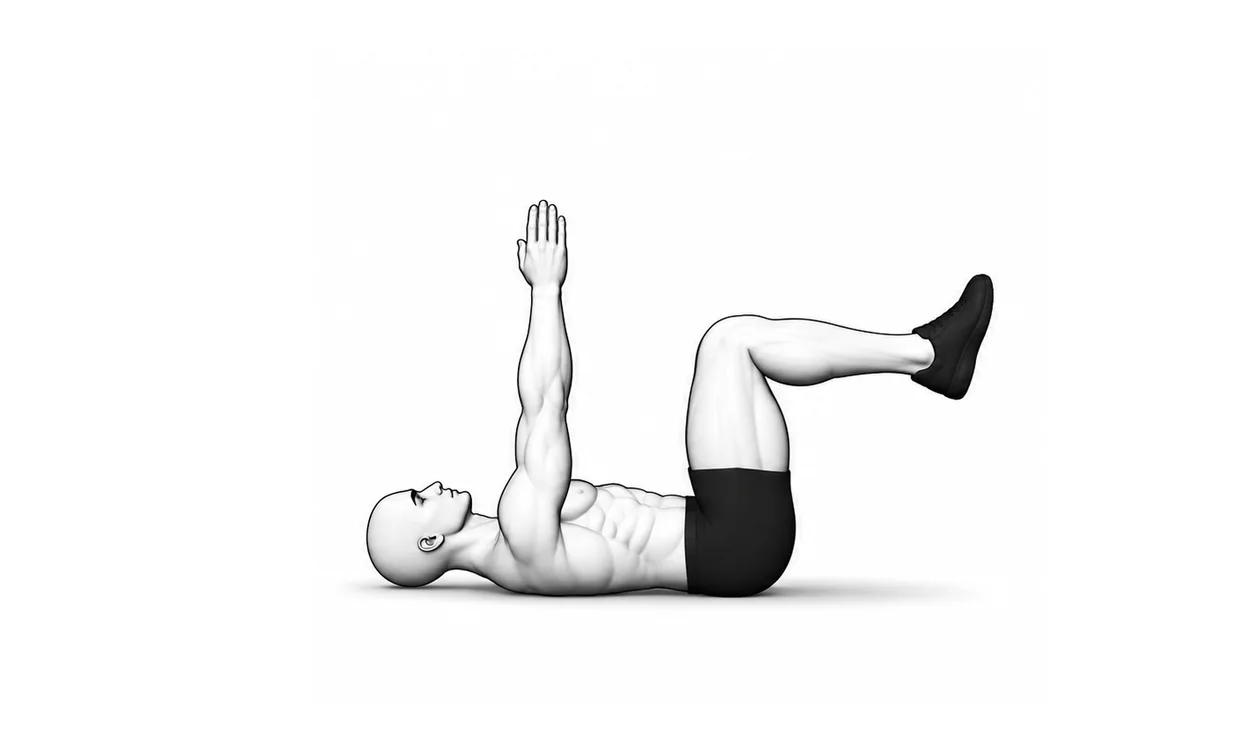
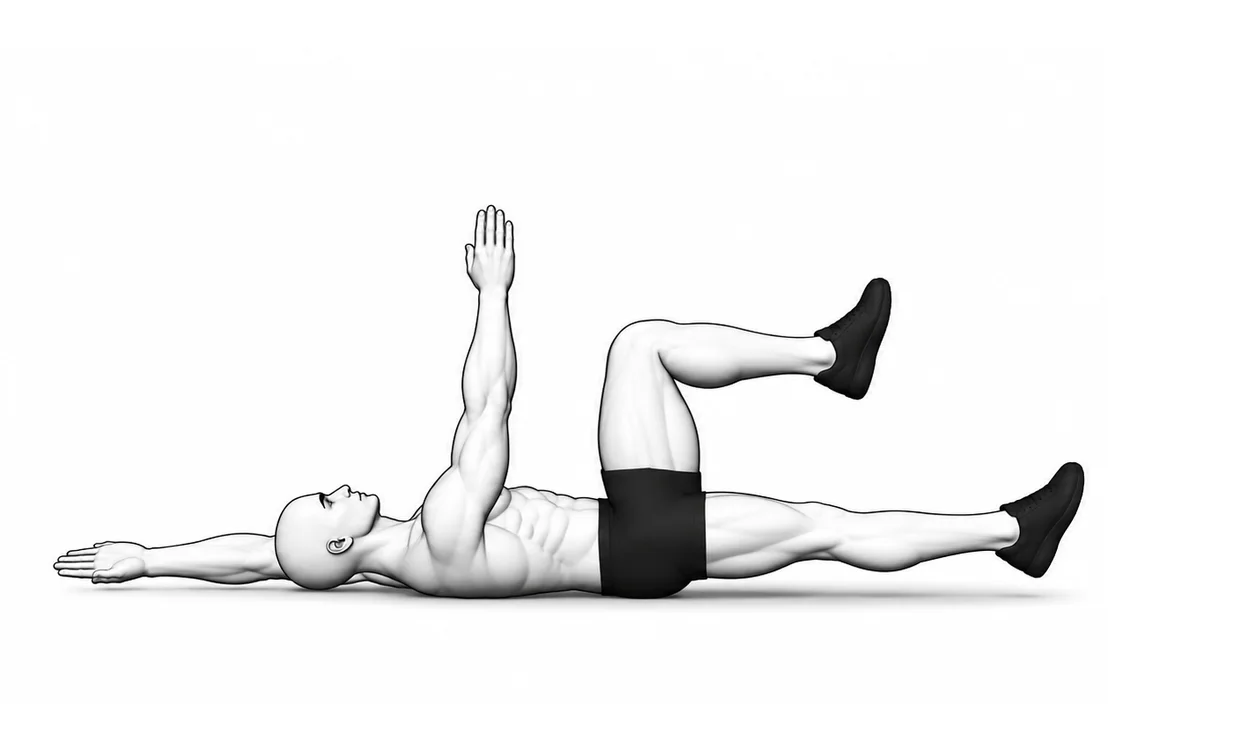
The dead bug is a core exercise done lying on your back. With your arms up and knees bent over your hips, you slowly lower one arm and the opposite leg towards the floor while keeping your lower back pressed down, then switch sides.
- TYPE
- Core: your trunk holds still while your arms and legs move
- PRIMARY MUSCLES
- Abdominals: rectus abdominis and the obliques
- ALSO WORKING
- Hip flexors, deep core muscles
- EQUIPMENT
- None; a mat for comfort
- DIFFICULTY
- Beginner
Form images
Muscles worked
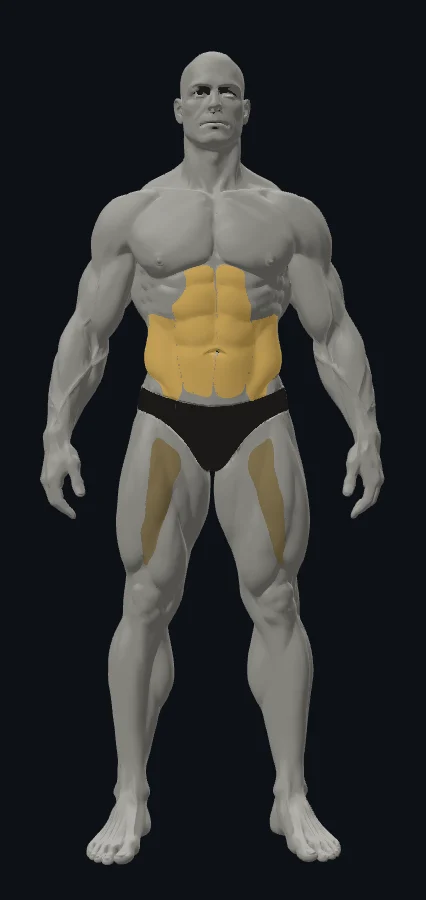
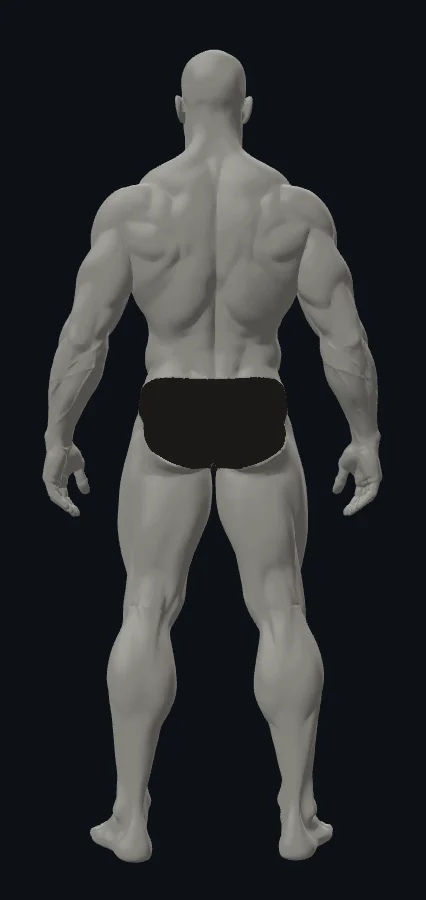
- PRIMARY
- Abdominals: rectus abdominis and the obliques
- ASSISTING
- Hip flexors, deep core muscles
The dead bug trains your abdominals to keep your lower back still while your arms and legs pull on it.
- Abdominals stop your lower back from arching off the floor. Moving an arm and a leg together worked them harder than moving the arms alone, with the obliques showing the highest readings [1].
- Hip flexors lower and lift your legs.
Setup
- Lie on your back on a mat.
- Reach your arms straight up over your shoulders.
- Lift your legs so your hips and knees are bent at 90 degrees, shins level.
- Press your lower back flat into the floor and keep it there.
How to do it
- Breathe out and tighten your abs.
- Lower one arm back overhead and straighten the opposite leg out, together and slowly.
- Stop just above the floor, or sooner if your lower back starts to lift.
- Bring them back to the start.
- Switch sides and repeat.
from the start position to the arm and leg just above the floor, as far as your lower back stays flat.
about 3 seconds out, 3 seconds back.
Why slow, when a study found faster was harder? In a study of 30 adults, the abdominal muscles were more active when the dead bug was done to a faster beat [1]. That study measured muscle activity during the exercise, not strength or results over time, and fast reps make it much harder to keep your lower back on the floor, which is the whole point of the dead bug. So we recommend going slowly, and making it harder with a weight or a pause instead.
Common mistakes
Lower back arching off the floor
Your abs have lost the brace, and your back takes the strain
Shorten the reach until your back stays flat.
Rushing
Momentum moves the limbs, not control
Slow down; see the note on tempo above.
Holding your breath
You can't keep the brace for the whole set
Breathe out as you reach, in as you return.
Same arm and leg
It changes the exercise and makes it easier to cheat
Move the opposite arm and leg.
Make it easier or harder
Variations and alternatives
Abs, with less to control
The full version makes your back lift.
Same muscles, more load
10 slow reps a side are easy.
Abs, holding a straight line
You want a core hold face down.
Where to fit it into your workout
At the end of a session, or as part of a warm-up.
Sets and reps: 2–3 sets of 6–10 reps per side.
Rest: 30–60 seconds.
How often: two or three times a week.
What to pair it with: the plank.
Safety
- Keep your lower back on the floor. Stop each reach before it lifts.
- Move slowly; don't let your arms or legs drop.
- Check with a doctor or physical therapist first if you have an injury, pain or a medical condition, or are pregnant.
- Stop the set if you feel sharp pain, joint pain, dizziness or chest pain. Muscle burn and effort are normal; pain is not.
- This page is general information about exercise technique. It isn't medical advice and doesn't replace advice from a professional who knows your health. See our Terms of Service.
Questions people ask
What are the benefits of the dead bug?
It trains your abs to keep your lower back still while your arms and legs move, with no load on your spine and no equipment.
What muscles does the dead bug work?
Mainly the abdominals, including the obliques, plus the hip flexors [1].
Should I do the dead bug on each side?
Yes: alternate sides, and count each side as one rep.
Can I do the dead bug with weight?
Yes, once the bodyweight version is easy. Hold a light dumbbell in each hand.
Sources
- 1Yun BG, Lee SJ, So HJ, Shin WS. Changes in muscle activity of the abdominal muscles according to exercise method and speed during dead bug exercise. Phys Ther Rehabil Sci. 2017;6(1):1–6.