Cable Lateral Raise
The cable lateral raise is a one-arm side raise against a low cable. Standing side-on to the machine, you lift the handle out to the side to shoulder height. The cable pulls across your body, so the side of your shoulder is loaded even at the bottom, where a dumbbell weighs almost nothing.
- TYPE
- Isolation: works the shoulder joint only
- PRIMARY MUSCLES
- Side (lateral) deltoids
- ALSO WORKING
- Supraspinatus, upper traps, front deltoids
- EQUIPMENT
- A cable station with a low pulley and a single handle
- DIFFICULTY
- Beginner
Form images
Muscles worked
- PRIMARY
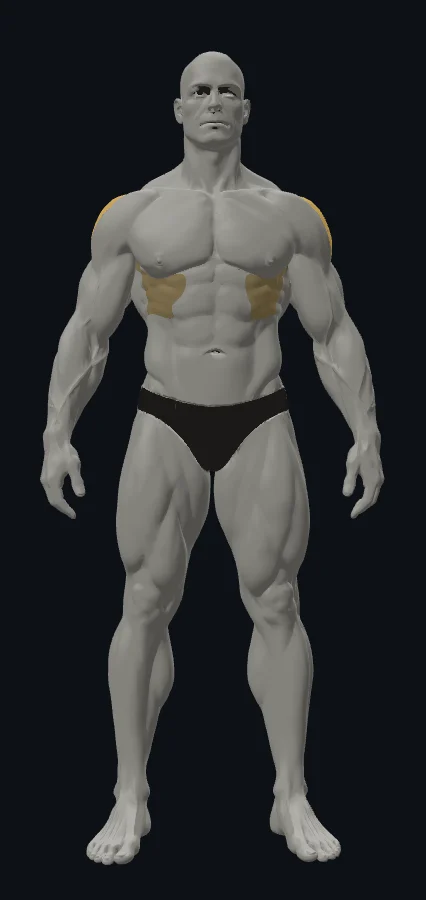
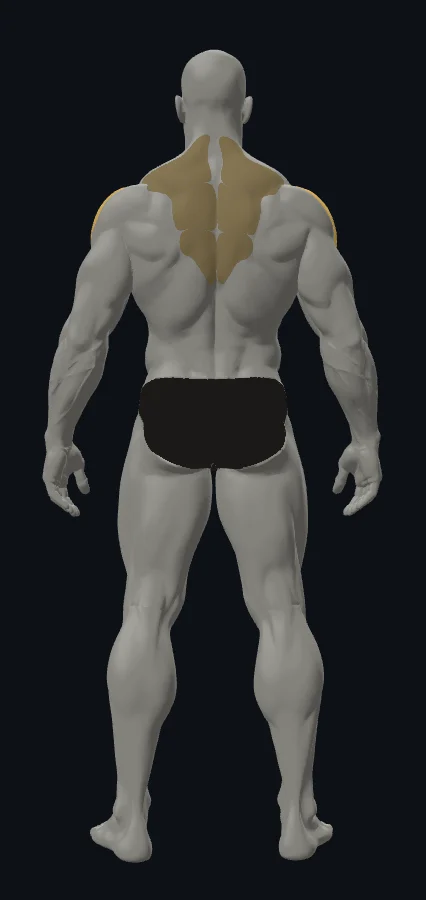
- Side (lateral) deltoids
- ASSISTING
- Supraspinatus, upper traps, front deltoids
Like the dumbbell version, the cable lateral raise is a side-delt exercise. What changes is where it feels hardest.
- Side deltoids lift the arm. The low cable loads them from the very start of the rep, when the arm is across the body and the muscle is at its longest. In trained lifters, eight weeks of cable or dumbbell raises grew the side delts by the same amount [1].
- Supraspinatus, a rotator cuff muscle, helps start the raise.
- Upper traps join in if you shrug or raise the arm too high.
- Front deltoids help steady the arm.
Setup
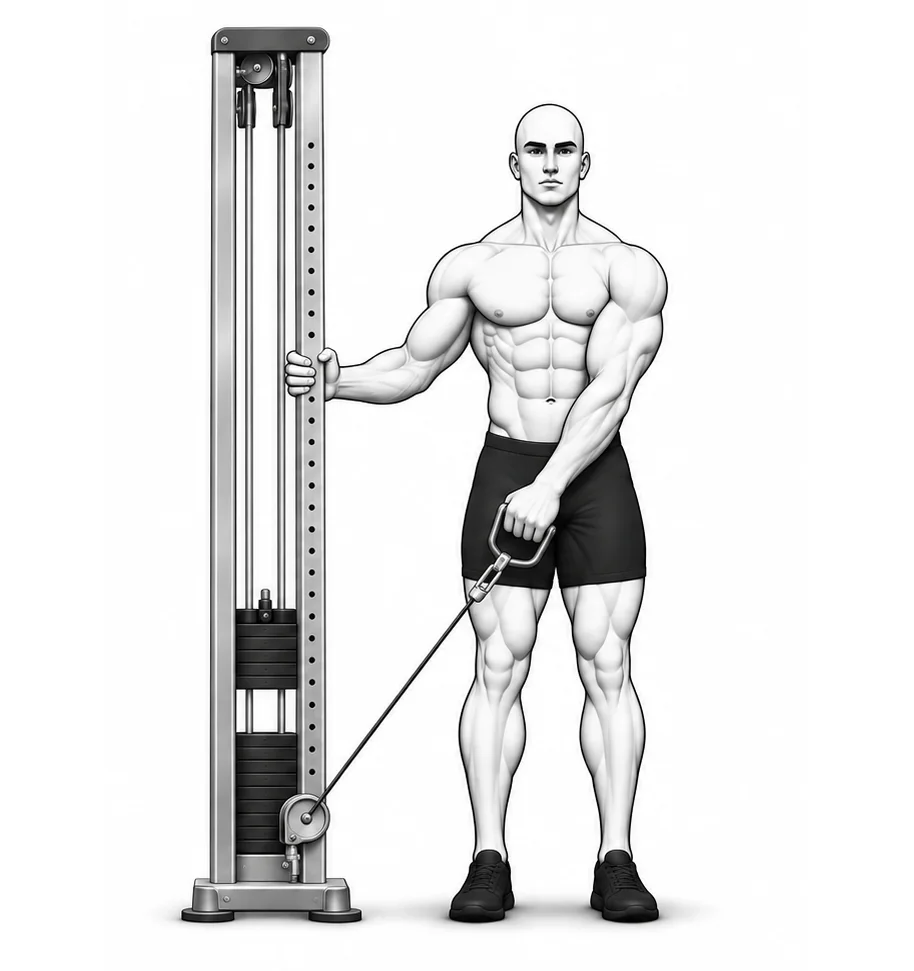
- Set the pulley at its lowest position and clip on a single handle.
- Stand side-on to the machine, about a step away, feet hip-width apart.
- Take the handle in the hand farther from the machine, so the cable runs across the front of your body.
- Hold the frame with your free hand, and lean very slightly away from the machine if that feels steadier.
- Set your shoulders down and put a slight bend in the working elbow.
How to do it
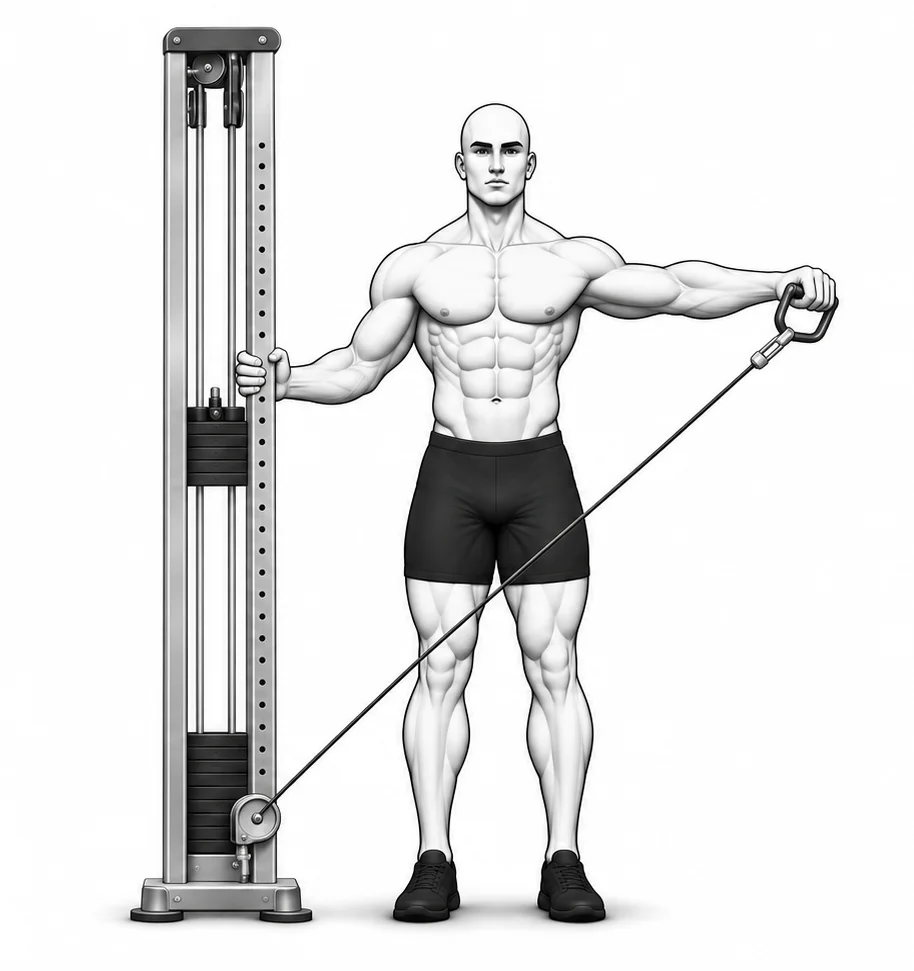
- Raise the arm out to the side in a wide arc, elbow leading the hand.
- Stop at shoulder height, with the elbow slightly above the wrist.
- Pause briefly.
- Lower slowly back across your body, letting the cable pull your arm in until the shoulder is stretched.
- Finish every rep on this arm, then turn round and train the other.
from the hand in front of the body to the upper arm level with the shoulder.
about 1 second up, a short pause, and 2–3 seconds down.
Common mistakes
Leaning or twisting away from the machine to start the rep
Your torso, not your shoulder, moves the handle
Hold the frame, keep your hips square, and use less weight.
Cutting the bottom short
You skip the stretched part of the rep, where the cable is most useful
Let the arm come back across your body each rep.
Shrugging
The upper traps take over from the side delt
Keep the working shoulder down, away from your ear.
Bending the elbow more as you lift
It shortens the lever, so you're lifting less than it feels like
Fix the slight bend at the start and keep it.
Make it easier or harder
Variations and alternatives
Side deltoids, with a little more rear delt
The front-of-body version feels awkward on your shoulder.
The same side deltoids, with no grip
Your grip gives out before your shoulder.
The same side deltoids [1]
You have no cable, or want to train both arms at once.
Side deltoids, on a fixed path
You want the arc guided.
Rear deltoids and upper back
You want the back of the shoulder instead.
Where to fit it into your workout
Place: after your presses, in a shoulder or upper-body session.
Sets and reps: 2–4 sets of 10–20 per arm. Light loads built muscle as well as heavy ones when sets ended close to failure [2].
Rest: none needed between arms; about a minute before you start the first arm again.
How often: two or three times a week [3]. In the training study, two sessions a week were enough to grow the side delts [1].
What to pair it with: a rear delt fly, so the side and back of the shoulder are both trained.
Safety
- Pick a weight you can lower slowly. The cable pulls your arm across your body at the bottom; let it, but under control.
- Return the handle to the bottom under control before you let go; don't let the stack crash.
- Check with a doctor or physical therapist first if you have an injury, pain or a medical condition, or are pregnant.
- Stop the set if you feel sharp pain, joint pain, dizziness or chest pain. Muscle burn and effort are normal; pain is not.
- This page is general information about exercise technique. It isn't medical advice and doesn't replace advice from a professional who knows your health. See our Terms of Service.
Questions people ask
Are cable lateral raises better than dumbbell lateral raises?
Not for growth. In a study of trained lifters, each person trained one arm with cables and the other with dumbbells for eight weeks, and both arms' side delts grew by about the same amount [1]. Use whichever you'll do consistently, or both.
What muscles does the cable lateral raise work?
Mainly the side deltoids, with the supraspinatus, upper traps and front deltoids helping.
Is the cable lateral raise a push or a pull?
Neither, strictly: it's a raise. Most programs put it on push or shoulder days, after the presses.
Sources
- 1Larsen S, Wolf M, Schoenfeld BJ, et al. Dumbbell versus cable lateral raises for lateral deltoid hypertrophy: an experimental study. Front Physiol. 2025;16:1611468.
- 2Schoenfeld BJ, Grgic J, Ogborn D, Krieger JW. Strength and hypertrophy adaptations between low- vs. high-load resistance training: a systematic review and meta-analysis. J Strength Cond Res. 2017;31(12):3508–23.
- 3Schoenfeld BJ, Ogborn D, Krieger JW. Effects of resistance training frequency on measures of muscle hypertrophy. Sports Med. 2016;46(11):1689–97.