Seated Calf Raise
The seated calf raise trains your calves with your knees bent. Sitting with a pad across your lower thighs, you lower your heels into a stretch, then push the pad up by rising onto your toes.
- TYPE
- Isolation: works the ankle only
- PRIMARY MUSCLES
- Soleus (the deeper calf muscle)
- ALSO WORKING
- Gastrocnemius, a little
- EQUIPMENT
- Seated calf raise machine
- DIFFICULTY
- Beginner
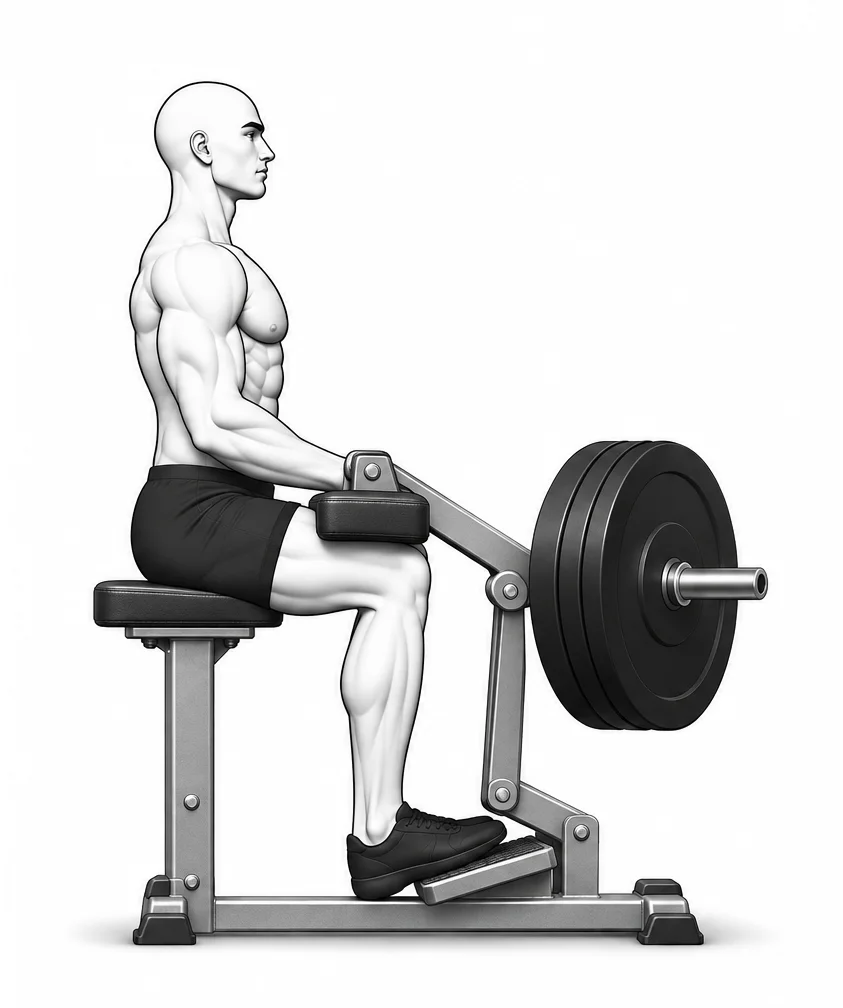
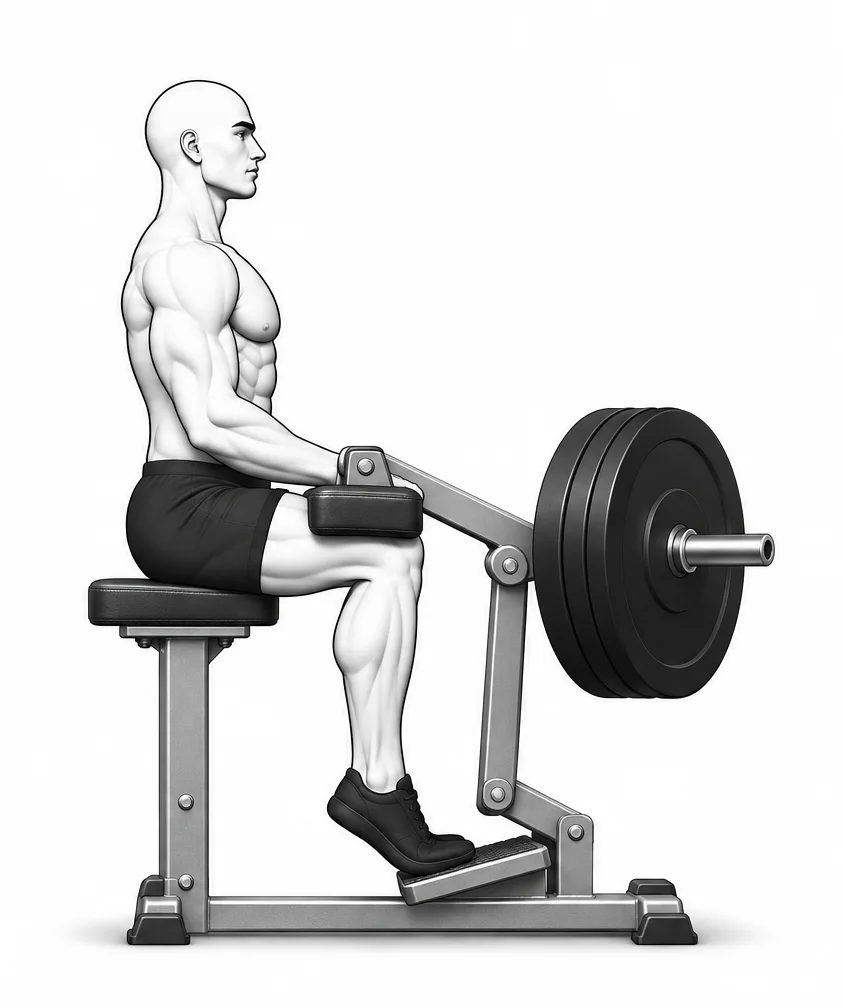
Form images
Muscles worked
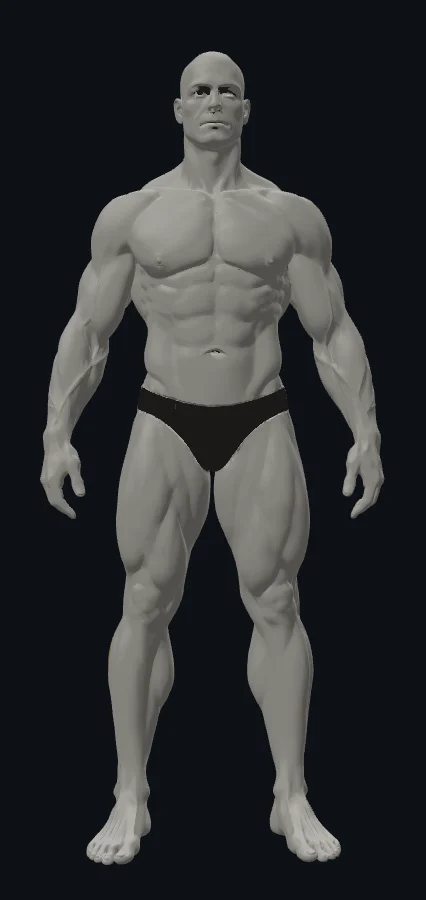
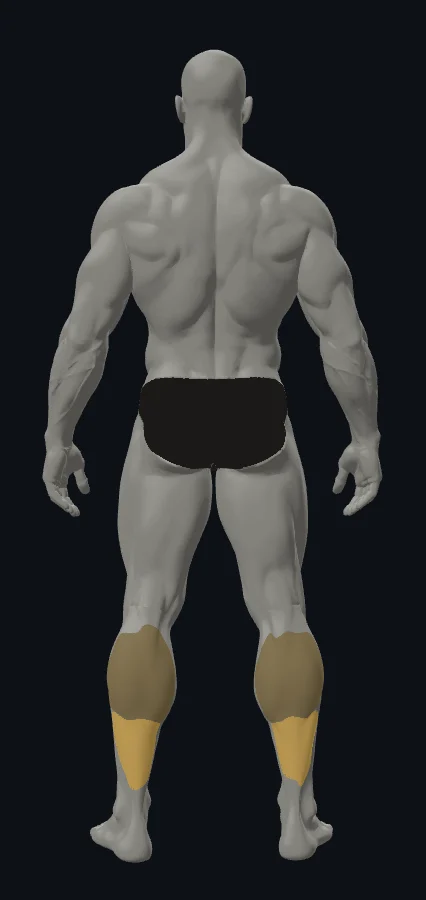
- PRIMARY
- Soleus (the deeper calf muscle)
- ASSISTING
- Gastrocnemius, a little
The seated calf raise mainly works the soleus. With your knees bent, the larger gastrocnemius can't do much.
- Soleus sits under the gastrocnemius and crosses only the ankle, so it works whether your knees are bent or straight.
- Gastrocnemius crosses the knee too, and goes slack when the knee bends. Twelve weeks of seated calf raises barely grew it, while standing raises did [1].
Setup
- Sit on the machine with the balls of your feet on the platform edge and your heels hanging off.
- Set the knee pad so it sits snugly across your lower thighs, just above your knees.
- Rise slightly onto your toes and release the safety lever.
How to do it
- Let the platform take your heels down under control until the back of your lower leg is fully stretched.
- Hold the bottom for a full second, with no bounce.
- Drive the pad upwards through the ball of your foot and big toe.
- Hold the top briefly with your heels as high as they'll go.
- Lower again and keep going. When the set ends, flip the safety lever back in before you slide out.
heels from fully dropped below the platform edge up to full tiptoe.
a controlled 2-second drop, a full second's hold at the bottom, then a steady drive up.
Common mistakes
Bouncing at the bottom
Your tendons spring you up and the calves do less
Pause in the stretch before every rep.
Short reps
Skips the stretched position
Lower your heels fully every rep.
Lifting with your thighs
Your legs push the pad, not your calves
Keep your thighs relaxed and move only at the ankle.
Pad too loose
The weight shifts and the start is unstable
Set the pad snug before you release the safety.
Make it easier or harder
Variations and alternatives
Soleus, with dumbbells on your knees
You don't have the machine.
Gastrocnemius much more, and the calves overall [1]
You only have time for one calf exercise.
Mostly the gastrocnemius, legs straight
The calf machines are busy.
Where to fit it into your workout
Place: last in the leg session, straight after the standing version, as a top-up for the soleus.
Sets and reps: 2–3 sets; higher reps, 12–20, suit this machine. Heavy and light loads built similar muscle when the sets ended close to failure [2].
Rest: a minute or less.
How often: two or more calf sessions each week [3].
What to pair it with: the standing calf raise, done first.
Safety
- Release and re-engage the safety lever with the weight on your toes, not on your knees.
- Lower under control into the stretch; don't drop into it.
- Check with a doctor or physical therapist first if you have an injury, pain or a medical condition, or are pregnant.
- Stop the set if you feel sharp pain, joint pain, dizziness or chest pain. Muscle burn and effort are normal; pain is not.
- This page is general information about exercise technique. It isn't medical advice and doesn't replace advice from a professional who knows your health. See our Terms of Service.
Questions people ask
Seated or standing calf raises: which is better?
Standing, for overall calf growth. In a 12-week study, standing raises grew the gastrocnemius by about 9–12%, while seated raises grew it by under 2% [1]. Seated raises are best as extra soleus work.
What are the benefits of seated calf raises?
They aim at the soleus, the deeper calf muscle, and need no balance.
Can I do a seated calf raise without a machine?
Yes. Sit on a bench with the balls of your feet on a plate or step and rest dumbbells on your knees.
Sources
- 1Kinoshita M, Maeo S, Kobayashi Y, et al. Triceps surae muscle hypertrophy is greater after standing versus seated calf-raise training. Front Physiol. 2023;14:1272106.
- 2Schoenfeld BJ, Grgic J, Ogborn D, Krieger JW. Strength and hypertrophy adaptations between low- vs. high-load resistance training: a systematic review and meta-analysis. J Strength Cond Res. 2017;31(12):3508–23.
- 3Schoenfeld BJ, Ogborn D, Krieger JW. Effects of resistance training frequency on measures of muscle hypertrophy. Sports Med. 2016;46(11):1689–97.